
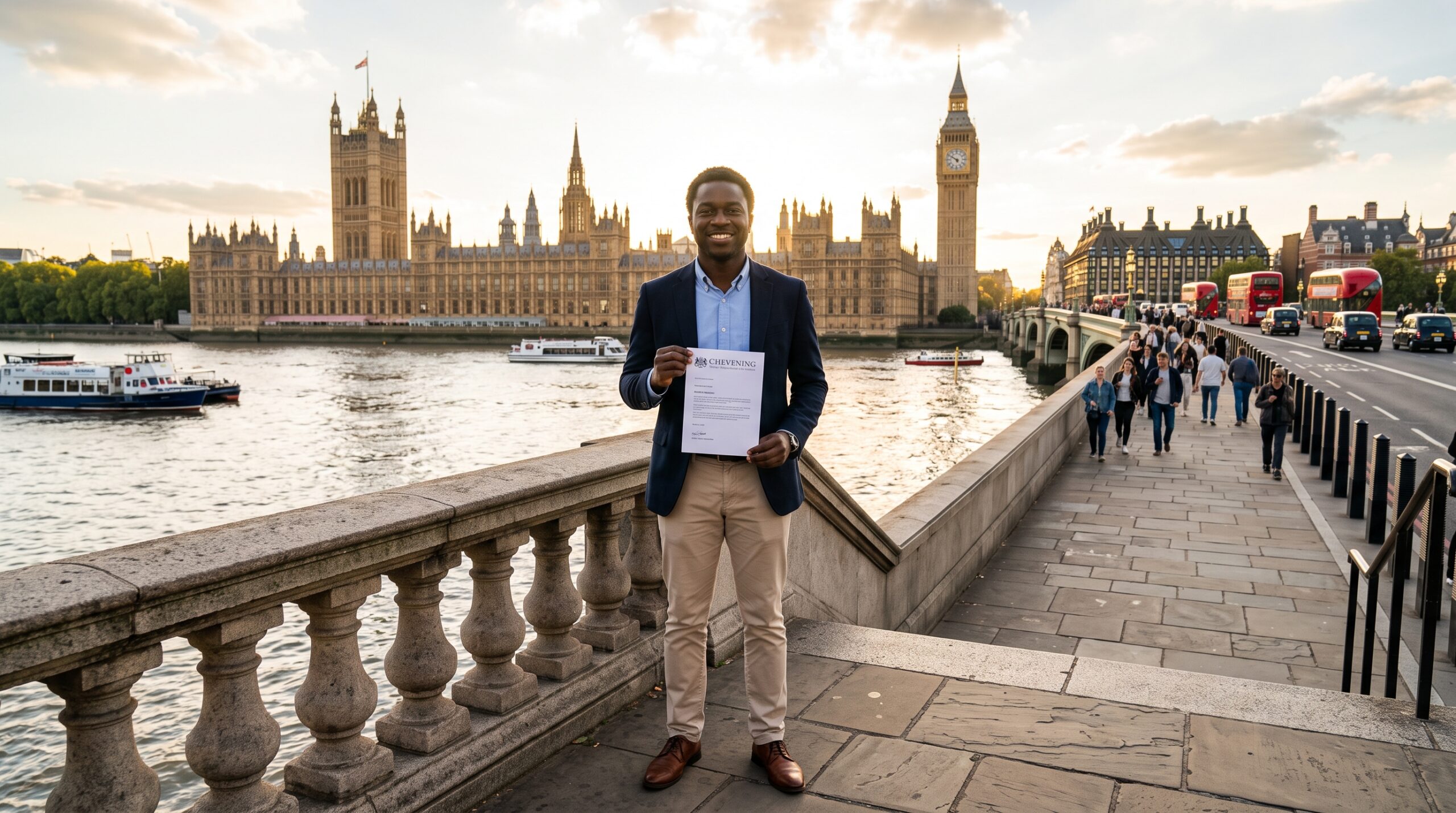
The Chevening Scholarship is the United Kingdom Government’s flagship international scholarship programme — funded by the Foreign, Commonwealth and Development Office (FCDO) and partner organisations, and one of the most prestigious UK fully funded scholarships available to international students worldwide. Since 1983, Chevening has funded more than 60,000 scholars from over 160 countries and territories, building a global network of leaders, policymakers, academics, and innovators who maintain lifelong ties with the United Kingdom. For the 2027-2028 cycle, the Chevening scholarship application portal is expected to open in August 2026 with a firm deadline of 7 October 2026.
This guide is the complete reference for every stage of the chevening scholarship application — who qualifies, how to calculate your work hours, what the four essays require, how the selection process works from submission through interview, and what separates winning applications from the 97% that are unsuccessful. Every fact in this guide is verified against official Chevening guidance. Nothing here is assumption or hearsay. If you are reading this in July 2026, you have the most valuable 4-week window available: publishing and preparing now, before the August portal opens, is the difference between a strong submission and a rushed one.
Chevening Scholarship 2027 — Quick Reference
| Detail | Information |
| Full Name | Chevening Scholarship 2027-2028 |
| Organisation | UK Foreign, Commonwealth and Development Office (FCDO) + partner organisations |
| Degree Level | One-year fully taught Master’s degree — any subject, any eligible UK university |
| Award Package | Full tuition fees + monthly living allowance (~GBP 1,347) + economy return airfare + visa application fee + arrival allowance + homeward departure allowance + travel grant for Chevening events |
| Work Experience | Minimum 2,800 hours post-graduation — can be combined from up to 15 employment periods |
| Scholarships Per Year | Approximately 1,800 globally |
| Acceptance Rate | Approximately 2–3% |
| Application Opens | August 2026 |
| Application Deadline | 7 October 2026 at 12:00 UTC |
| University Offer Deadline | Typically early July 2027 (for conditionally selected candidates) |
| Return Requirement | Must return to home country for minimum 2 years after scholarship ends |
| English Test | Chevening has no English language test requirement — individual UK universities set their own IELTS/TOEFL requirement |
| Eligible Countries | 160+ countries and territories — check chevening.org/apply for your country |
| Official Site | chevening.org |
What Does the Chevening Scholarship Cover? Full Package Breakdown
Chevening is classified as fully funded — and it genuinely is, in a way that many scholarships branded with that term are not. Here is the exact package:
| Benefit | What Chevening Covers |
| Full Tuition Fees | Paid directly to the university — covers the full course fee up to the programme fee cap with no limit on institution |
| Monthly Living Allowance | Approximately GBP 1,347 per month for the duration of the programme — paid to the scholar monthly |
| Economy Return Airfare | Return economy class flights from home country to the UK at the start and end of the scholarship |
| UK Visa Application Fee | The cost of one Tier 4 (Student) visa application — refunded to the scholar |
| Arrival Allowance | A one-time payment on arrival to cover initial UK setup costs |
| Homeward Departure Allowance | A one-time payment to cover costs of returning home at the end of the scholarship |
| Chevening Events Travel Grant | A travel grant to attend Chevening-organised events and conferences within the UK |
| UK Graduate Route Visa | NOT covered — Chevening scholars cannot apply for the UK Graduate Route visa after their studies; they must return home within their visa conditions |
| ⚠️ Graduate Route Visa Not Available to Chevening Scholars By accepting a Chevening award, scholars agree to return to their home country for a minimum of two years after the scholarship ends. This means Chevening scholars cannot apply for the UK Graduate Route visa (which normally allows graduates to remain in the UK for 2–3 years after graduation). If remaining in the UK after your degree is a priority, Chevening may not be the right scholarship for your circumstances. |
Chevening Scholarship Eligibility Criteria 2027 — Who Can Apply
The Chevening scholarship eligibility criteria are specific. Read every condition below before beginning your application. Failing any single condition makes your application ineligible regardless of how strong your essays are.
Who Is Eligible
- Citizenship: Must be a citizen of a Chevening-eligible country or territory — over 160 countries qualify. UK citizens, EU/EEA nationals (in most cases), and permanent residents of certain excluded territories are not eligible. Check chevening.org/apply for your specific country.
- Undergraduate Degree: Must hold an undergraduate degree equivalent to a UK 2:1 honours degree (upper second class). This is the minimum — not a recommended level, the requirement. The degree must have been completed by the time you submit your application.
- Work Experience: Must have at least 2,800 hours of post-graduation work experience by the application deadline. This is the post-graduation work experience rule — experience gained during your undergraduate degree does not count. See the full work hours section below.
- Return Commitment: Must commit to returning to your home country for a minimum of two years after your scholarship ends. This is a binding commitment, not a preference.
- University Course: Must apply to three different eligible UK master’s programmes at three different eligible UK universities within the application. At least one unconditional university offer must be secured after selection — before the July university offer deadline.
- English Language: Chevening itself does not set an English language test requirement. Your chosen UK universities will set their own IELTS or TOEFL requirements for admission.
Who Is NOT Eligible
- UK citizens — not eligible under any circumstances for Chevening Scholarships
- Dual UK citizens — not eligible even if you hold citizenship of a Chevening-eligible country
- Current UK permanent residents
- Previous recipients of a UK Government-funded scholarship (including Commonwealth Scholarships)
- Employees, former employees, or immediate family members of FCDO or certain partner organisations within the last two years
- Chevening partner organisation employees — they can apply but cannot receive an award from the specific organisation they are affiliated with
Chevening Work Experience Requirements — How to Calculate Your 2,800 Hours
The Chevening work experience requirements are the single most misunderstood part of the application, and the source of the majority of eligibility disputes. The confusion comes from two distinct rules: the 2,800-hour minimum, and the post-graduation restriction.
What Counts as Post-Graduation Work Experience for Chevening?
The chevening post-graduation work experience rule is simple but absolute: only work experience completed after your undergraduate degree graduation counts toward the 2,800-hour requirement. Internships, part-time jobs, and volunteering done during your undergraduate studies — however substantial — do not count, even if they were directly relevant to your field.
The following types of work all count, provided they were completed after your undergraduate degree:
- Full-time employment: Counts at your actual contracted hours per week
- Part-time employment: Counts at your actual hours worked per week — there is no minimum hours threshold
- Voluntary work: Counts as long as it is structured and documentable with specific hours
- Paid and unpaid internships: Both count — the payment status does not affect whether hours are eligible
- Freelance and self-employed work: Can count — you must be able to document the hours worked
Does Part-Time Work Count for Chevening?
Yes — does part-time work count for Chevening? The answer is an unqualified yes. Part-time work counts in full at your actual hours worked. Someone working 20 hours per week for 3 years accumulates 3,120 hours — more than the 2,800-hour minimum. Part-time work, voluntary work, and multiple concurrent roles can all be combined. You can enter up to 15 separate employment periods in the Chevening portal.
How to Calculate Chevening Work Hours
The Chevening portal calculates your chevening work hours automatically once you enter each employment period. The formula the system uses is:
| Hours Calculation Formula: Total Hours = (Number of weeks in the role) × (Hours worked per week) Worked example: Full-time role (40 hrs/week) for 18 months = 78 weeks × 40 hours = 3,120 hours ✅ Part-time role (20 hrs/week) for 2.5 years = 130 weeks × 20 hours = 2,600 hours Add: Volunteer role (10 hrs/week) for 6 months = 26 weeks × 10 hours = 260 hours Combined total = 2,860 hours ✅ (above the 2,800 minimum) |
| 📌 Enter Every Role — Even Short Ones Many applicants only enter their most significant roles and assume minor or short-term positions don’t matter. Enter every role — voluntary, part-time, freelance — because the system calculates the cumulative total. Every eligible hour counts toward your 2,800. If you are close to the threshold, missing even one three-month part-time role could take you below the minimum. |

How to Apply for Chevening Scholarship 2027 — Step by Step
Here is the complete how to apply for Chevening scholarship sequence for the 2027-2028 cycle. Work through these steps in order — several cannot be done at the last minute.
- Research your three UK university choices NOW (July 2026): Chevening requires you to name three different eligible master’s programmes at three different UK universities when you apply. Your choices must be coherent with your career narrative and leadership vision. Research the specific programmes, their content, their faculty, and their entry requirements in July — before the portal opens in August. Do not choose universities arbitrarily when the portal opens.
- Start writing your four essays NOW (July 2026): The Chevening application contains four essays of exactly 500 words each. They are the most important part of your application. First drafts are always weak. You need 6 to 8 weeks of drafting, feedback, and revision to produce essays that are genuinely competitive. Starting in August when the portal opens is too late for strong essays. Start now.
- Brief your two referees NOW (July 2026): Referees do not submit their letters when you submit your application — they submit independently after the October 7 deadline, during the independent reading committee review period. However, they need time to write a strong, specific letter. Contact them now, share your CV, explain what Chevening looks for, and confirm their availability.
- Create your Chevening portal account in August 2026: When the portal opens at chevening.org, register your account immediately. Do not wait until late September. Early registration gives you time to navigate the portal, understand the employment history entry system, and identify any documentation gaps before the deadline.
- Enter your employment history accurately: Each employment period is entered separately with the employer name, job title, start and end dates, hours per week, and a role description. Take your time with this — inaccurate hours can affect your eligibility assessment. Double-check your calculations against the formula above.
- Complete and submit all four essays: Each essay has a 500-word limit enforced by the portal. Going over the limit flags your application. Going significantly under suggests you have not fully answered the question. Aim for 490 to 500 words per essay.
- Submit before 7 October 2026 at 12:00 UTC: Convert UTC to your local timezone and set a deadline reminder 3 days earlier. The portal closes automatically. Portal congestion is real on deadline day — submit at least 72 hours before the cutoff.
Chevening Scholarship Timeline 2027-2028 — Key Dates
The chevening scholarship timeline for the 2027-2028 cycle follows the same annual pattern as previous years. Mark every date below from July onwards:
| Date | Stage | Action Required |
| July 2026 | Preparation window — CRITICAL | Write four essays, choose three UK universities, brief referees, check work hours |
| August 2026 | Application portal opens | Create account at chevening.org, begin application form |
| 7 October 2026 at 12:00 UTC | Application deadline | All essays, employment history, and university choices submitted |
| October–December 2026 | Eligibility review | Applications reviewed against eligibility criteria; ineligible applications removed |
| October–January 2027 | Independent reading committee | The Chevening independent reading committee reads and scores all eligible applications |
| Mid-February 2027 | Longlist to shortlist — interview invitations | Shortlisted candidates notified and invited for interview; referees notified to submit letters |
| March–April 2027 | Interviews at British Embassies and High Commissions | Interviews held globally; referees must submit letters by end of interview period |
| Mid-June 2027 | Results announced | Successful candidates receive their scholarship offer; when Chevening results come out |
| By early July 2027 | Unconditional university offer deadline | Conditionally selected scholars must submit at least one unconditional UK university offer |
| September/October 2027 | Studies begin in the UK | Scholars arrive in the UK and begin their master’s programmes |
Chevening Essay Word Limit and the Four Essays — What Each Question Asks
Every Chevening applicant must complete four essays. The Chevening essay word limit is exactly 500 words per essay — no more. Each essay targets one of the four selection criteria Chevening uses to evaluate candidates: leadership and influence, networking, career plan, and study in the UK. These four criteria are not equal in practice — the leadership essay and the career plan essay consistently receive the most scrutiny in the independent reading committee review. This guide covers all four.
| Essay | What It Asks | What Chevening Is Looking For |
| Essay 1 — Leadership & Influence | Describe a situation where you have had a positive influence on others. What did you do, and what was the impact? | Evidence of genuine leadership — not a job title, but a specific moment where your action directly changed outcomes for others |
| Essay 2 — Networking | Describe how you have used your networks in the past and how you plan to use the Chevening network in the future | Past evidence of deliberate networking for professional or community purpose, plus a credible plan for how you would use the Chevening alumni network specifically |
| Essay 3 — Career Plan | Where do you want to be professionally in ten years? How will your chosen master’s degree and the Chevening experience help you reach those goals? | A clear, specific, ambitious but realistic ten-year career trajectory with a direct connection between the UK degree and the stated goals |
| Essay 4 — Studying in the UK | Why have you chosen your three UK universities and course? Why is studying in the UK, specifically, important to your career plan? | A specific, research-based rationale for the chosen universities and programmes — not generic praise for UK education, but named reasons why these specific programmes serve your stated career goals |
How to Write Winning Chevening Essays — STAR Method and Examples
The STAR method Chevening essays framework — Situation, Task, Action, Result — is the most effective structural tool for answering Chevening’s leadership and networking essay questions. It gives reviewers exactly what they are trained to look for: a specific context, a clear challenge, what the applicant did personally, and a measurable or observable outcome. Essays that open with abstractions, values, or aspirations without getting to a specific example within the first paragraph score consistently lower than essays that begin with a concrete situation.
Essay 1 — Chevening Leadership and Influence Essay Examples
The Chevening leadership and influence essay is not asking what kind of leader you are in general. It is asking for a specific past example — one situation where you personally took action that influenced others and produced a positive outcome. The most common mistake is spending 250 words on context and values before getting to the actual action.
| Strong Opening (STAR Method — starts with Situation immediately): In 2023, rising dropout rates among girls in our NGO’s after-school literacy programme — 40% by the end of term — threatened to close a project serving 120 children in three underserved communities. As Programme Coordinator, I identified that transportation costs, not academic disinterest, were driving attrition. I negotiated a community van-pooling arrangement with two local business owners at zero programme cost, redistributed our existing community health budget to cover the remaining transport gap, and launched a parent engagement committee that shifted decision-making on scheduling to the families themselves. By the end of the following term, dropout had fallen to 6%, and the parent committee model was adopted by two neighbouring NGOs. The experience taught me that sustainable solutions to complex social problems rarely require more resources — they require listening to the community rather than assuming the problem. Why this works: It opens in the Situation immediately, names the specific Task (reducing 40% dropout), describes the Action with specifics (the van-pooling negotiation, the budget reallocation), gives a measurable Result (6% dropout, adopted by two other NGOs), and ends with a genuine reflection rather than a generic lesson. |
How to Write the Chevening Networking Essay
The how to write Chevening networking essay question trips up many applicants who interpret ‘networking’ as LinkedIn connections or conference attendance. Chevening means something specific: professional relationships that you deliberately built for a purpose, and that you used to create impact — not just social capital for its own sake. The essay has two distinct parts that must both be addressed within 500 words: past evidence of networking, and a specific plan for using the Chevening network.
The most common failure mode in this essay is spending 400 words on past networking examples and only 3 sentences on the Chevening network plan. The two parts must be roughly balanced. Name specific professional communities, alumni networks, or organisations you would target through the Chevening network, and explain what you would do with those connections — not abstractly, but with reference to your specific career plan.
Chevening Career Plan Essay Guide
The Chevening career plan essay guide section of the application asks where you want to be professionally in ten years and how the UK master’s and Chevening experience help you get there. Two elements make this essay strong or weak:
First, specificity of the ten-year vision. ‘I want to be a leader in public health policy’ is weak. ‘I want to be directing Pakistan’s Federal Health Data and AI Integration Programme — a policy framework I intend to develop during my Master’s in Health Data Science at the University of Edinburgh and pilot in two districts on returning home’ is strong. The specific programme, the specific policy work, and the specific link to the degree all give reviewers confidence that your career plan is real and thought-through rather than an aspiration produced for the application.
Second, a logical chain connecting your degree choice to your career goal. The master’s you chose must obviously serve the career plan you describe. If your ten-year goal is in education policy and your chosen master’s is in finance, the essay will be penalised regardless of how well-written it is. Consistency across the application — the same career goal reflected in the career plan essay, the university choices essay, and your referees’ letters — is one of the strongest signals a competitive application sends.
Chevening Studying in the UK Essay
The Chevening studying in the UK essay is the most frequently underwritten of the four. Applicants who spend 400 words on why UK education is generally excellent and only 100 words on their specific programme choices will score poorly here. The selection committee already knows UK education is excellent — they want to know why these specific three programmes at these specific three universities are the right fit for your specific career plan.
For each of your three choices, name the programme, explain one or two specific curriculum elements or research specialisations that connect to your career goal, and if possible name a faculty member whose work you have read. This level of specificity signals that you have actually researched the programmes — not simply picked three well-known names. The essay should also explain why studying in the UK specifically, rather than in another country, matters for your professional development. Connections to UK professional networks, UK research leadership in your field, or UK policy frameworks relevant to your home country are all legitimate angles.

Chevening Longlist vs Shortlist — What Happens After You Submit
The Chevening longlist vs shortlist distinction matters for understanding what to expect between October and February. Here is the full selection sequence:
After the October 7 deadline, the Chevening team first reviews all applications for eligibility — confirming that work experience hours are met, citizenship is verified, and university choices are eligible. Applications that fail eligibility are removed from the pool at this stage without progressing further.
Eligible applications then go to the Chevening independent reading committee — panels of trained assessors who read every application against the four selection criteria. The reading committee produces a longlist of candidates. Being longlisted means your application scored sufficiently well with the reading committee to advance to the next stage.
From the longlist, British embassies and high commissions in each country produce a shortlist of candidates for interview. Being shortlisted is the point at which referees are notified and must submit their reference letters through the portal. Interviews are held at British embassies and high commissions between March and April.
| 📌 Chevening Reference Letter Template — How References Work Your referees do not submit letters at the time you submit your application. Their details — name and professional email address — are entered into the application form, and they receive an email invitation to submit their letters independently after the October 7 deadline. They must submit before the end of the global interview period (approximately April 2027). Brief your referees in July 2026, give them your CV and essay drafts, and confirm they will submit when they receive the Chevening portal invitation. |
Chevening Scholarship Interview Questions — How to Prepare
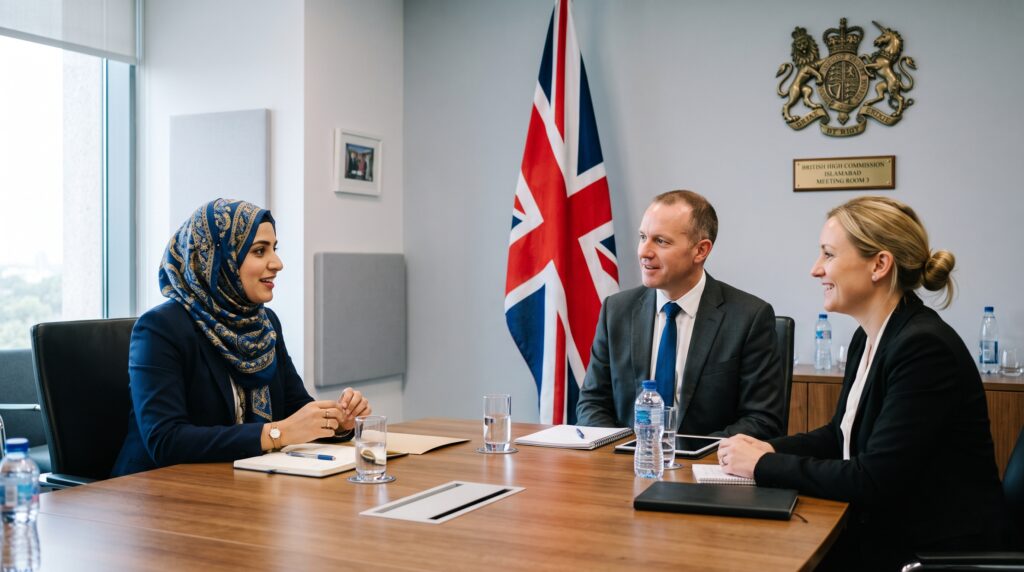
The Chevening scholarship interview questions are conducted at British embassies and high commissions by panels of typically three interviewers, including Chevening alumni and FCDO representatives. Interviews last approximately 30 minutes. The format is structured and standardised — all candidates in a country face the same core questions.
The Most Common Chevening Interview Question Areas
- Your leadership experience: Expect follow-up questions on the specific leadership example in your Essay 1. Interviewers ask for additional detail about situations you described, the obstacles you faced, and what you would do differently. Your essay example must be real — it will be probed deeply
- Your career plan: ‘Walk me through your ten-year career plan’ is a near-universal Chevening interview question. Your answer must be specific, consistent with your essay, and credibly connected to your UK degree choice. Vague answers about ‘wanting to make an impact’ score poorly
- Your networking strategy: ‘How do you plan to use the Chevening network?’ is asked in almost every interview. Name specific Chevening alumni working in your field or your country, explain what you would learn from or do with those connections, and show that you have actually researched the alumni network before the interview
- Your UK university choice: ‘Why this university? Why this programme?’ expects specific curriculum knowledge. Name modules, professors, research groups, or unique programme features that connect to your stated career goal
- Current affairs and sector knowledge: Questions about current challenges in your professional field, your country’s development context, or UK-country relations are common. Prepare three to five current issues directly relevant to your career area and have informed views on each
British Embassy Chevening Interview Tips
- Treat it as a professional panel, not a scholarship interview. Chevening selects future leaders — dress and communicate accordingly. Formal business attire. Direct, confident speech. Use first names of committee members if introduced. Do not be overly deferential
- Prepare a 2-minute ‘who are you’ answer. Almost every interview opens with ‘Tell us about yourself.’ Your 2-minute answer should cover: your academic background, the most significant professional achievement since graduating, what you are working on now, and why you are applying for Chevening this year. Practise it until it flows naturally without sounding rehearsed
- Know your essays word for word. Every question in the interview will reference something you wrote in your essays. If you cannot speak naturally about the leadership example in Essay 1 or the career trajectory in Essay 3, the committee notices that the essays do not authentically represent your experience
- Practise a mock interview with a real person. Recording yourself answering questions on your phone is useful for catching verbal habits. But nothing replaces a Chevening mock interview with a real person who will interrupt, challenge, and ask follow-up questions. A mentor, senior colleague, or previous Chevening applicant is ideal
- Have a 30-second answer for ‘What is your biggest weakness?’ This question or a variant (‘What would your referees say you need to work on?’) appears frequently. Do not say ‘I work too hard.’ Name a genuine professional limitation, explain what you are doing to address it, and connect it briefly to why the UK master’s programme helps
Chevening Conditional vs Unconditional Selection — University Offers Explained
The Chevening conditional vs unconditional selection distinction is one of the most confusing aspects of the application for first-time applicants. Here is exactly how it works:
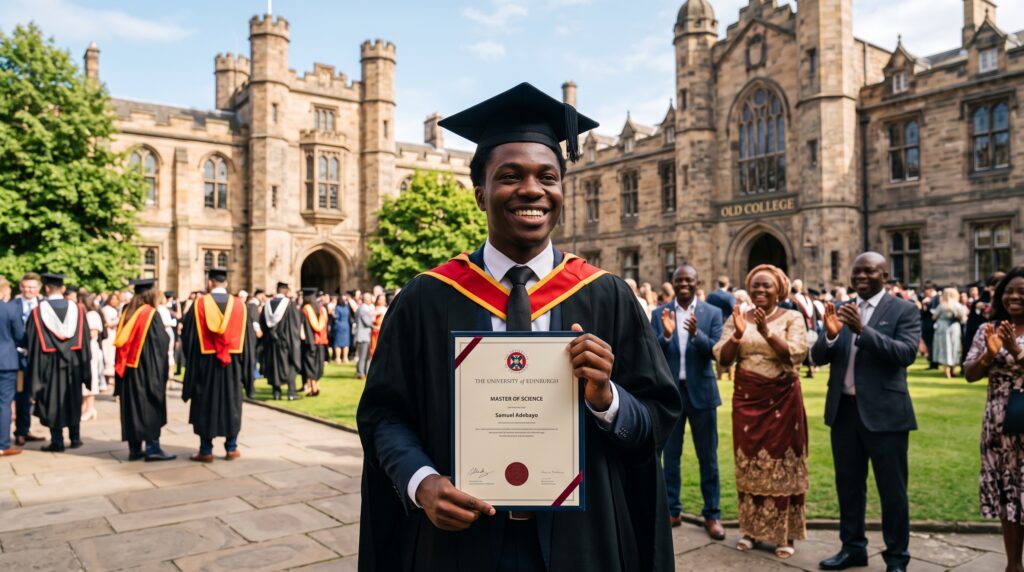
When Chevening announces results in mid-June, successful candidates receive a ‘conditional’ scholarship offer — conditional on securing at least one unconditional offer from one of their three chosen UK universities by the specified deadline (typically early July). Chevening does not apply to universities on your behalf. You must apply to your three chosen UK programmes yourself, through UCAS or each university’s own international application portal, entirely separately from your Chevening application.
The timing creates a practical challenge: UK university applications for September entry typically have deadlines in December through March. If you apply to Chevening in October 2026 and receive your conditional selection in June 2027, you have very little time to secure a university offer before July 2027. The practical solution is to apply to your three chosen UK universities as early as possible — ideally in September or October 2026 alongside your Chevening submission — so that offers can come in by December or January, well before the July university offer deadline.
| 📌 Apply to UK Universities at the Same Time as Chevening Many unsuccessful Chevening candidates who receive conditional offers fail to convert them because they left university applications too late. Apply to your three chosen UK universities in September or October 2026 — the same month you submit your Chevening application. This gives you the best chance of having unconditional offers in hand well before the July 2027 deadline. Track application requirements for each university (IELTS, personal statement, portfolio if required) as part of your July preparation. |
Documents Needed for Chevening Scholarship Application 2027
| Chevening Scholarship 2027 — Complete Document Checklist Valid Passport — must not expire during your intended study period in the UK; visa processing timelines make a minimum 18-month validity advisable Online Application — completed through the Chevening portal at chevening.org; work experience must be entered for each employment period individually Four Completed Essays — Leadership and Influence, Networking, Career Plan, and Studying in the UK — each exactly 500 words; over-word applications are flagged Details of Two Referees — names and professional email addresses entered into the application form; referees submit their own letters independently through the Chevening portal after the deadline Three UK University Course Choices — all three must be different eligible master’s programmes at different eligible UK universities; research these before the portal opens in August Work Experience Records — for each employment period, you will need: employer name, job title, start and end dates, hours per week, and a description of duties; up to 15 employment periods can be combined Undergraduate Degree Certificate — you will need details of your qualifying undergraduate degree; the degree must be equivalent to a UK 2:1 honours and must have been completed at least 2 years before the application deadline English Proficiency Evidence — Chevening does not set its own English language test requirement; however, your chosen UK universities will require IELTS, TOEFL, or equivalent for admission; have your test certificate ready for when you apply to universities separately Unconditional University Offer — NOT required for your Chevening application submission; required only if you are conditionally selected and must be submitted by the July university offer deadline; apply to your chosen UK universities as soon as possible after receiving your Chevening selection |
Top 8 Tips to Win the Chevening Scholarship 2027
- Start your essays in July — every week you delay is a week of revision you lose. The portal opens in August with a 10-week window to October 7. Strong Chevening essays go through 4 to 6 serious revision cycles. Applicants who start drafting in July consistently submit stronger essays than applicants who start when the portal opens. You now have this window. Use it.
- Choose your three universities in July based on programme alignment, not prestige. Choosing Oxford, Cambridge, and Imperial because of their rankings — rather than because their specific master’s programmes connect to your career goal — is the most common and most penalised mistake in the UK study essay. Research three programmes whose curriculum, research specialisations, and faculty match your stated career trajectory. Read the module lists. If you cannot name two specific reasons why Programme X serves Career Goal Y, you have not researched enough.
- Your leadership example must be post-undergraduate and specific. The leadership essay is assessed on specificity and scale of impact. A leadership example from your undergraduate student union years scores lower than one from your professional career. A leadership example where you describe your general approach scores lower than one describing a specific situation with measurable outcomes. Use the STAR framework and start with the situation in sentence one
- Apply to your chosen UK universities in October 2026, simultaneously with your Chevening submission. Conditional Chevening selection means nothing if you cannot produce a university offer by July 2027. UK Master’s application timelines are tight. Apply in October or November 2026 so offers arrive in December through March — leaving months of buffer before the university offer deadline
- Contact Chevening alumni in your field before the interview. Chevening alumni are expected to be findable — the network is one of the scholarship’s core selling points. Before your interview, identify two or three Chevening alumni working in your sector or country and research their work. Referencing specific alumni by name and explaining what you would learn from connecting with them demonstrates genuine engagement with the network rather than generic enthusiasm
- Your career plan must be the same across all four essays. Reading committees read all four essays together. A candidate who describes a ten-year goal in public health in Essay 3 but chooses a law programme at LSE in Essay 4 will be flagged for inconsistency. A candidate who describes networking with economists in Essay 2 but lists education programmes in Essay 4 creates confusion. Every essay must point toward the same career direction from a different angle
- Brief referees with your essays — not just a generic request. Referees who write generic letters (‘I am pleased to recommend…’) do not add material weight to your application. Referees who write letters that specifically reference your leadership example from Essay 1, confirm the career plan in Essay 3 from their own professional observation of your work, and describe concrete professional contributions you have made — those letters corroborate your essays and significantly strengthen the overall application. Give your referees your four essay drafts when you brief them in July
- Apply in this cycle even if you feel you are not ready. Many current Chevening scholars applied in a previous cycle, were rejected, and then won in a subsequent application. The discipline of completing a full application — drafting four essays, researching universities, calculating your hours, briefing referees — makes your next application substantially stronger regardless of this cycle’s outcome. A rejection is not a closed door. It is feedback that, combined with another year of professional experience, often produces the winning application the following year
Frequently Asked Questions — Chevening Scholarship Application 2027
Q1: How competitive is the Chevening Scholarship?
Extremely competitive. Approximately 1,800 scholarships are awarded annually from tens of thousands of applications across 160+ countries — an estimated acceptance rate of around 2 to 3 percent globally. The effective competition rate varies significantly by country: countries with smaller Chevening quotas and large applicant pools (India, Nigeria, Pakistan) tend to be more competitive than countries with larger per-country allocations relative to their applicant base. The selection process has three stages — eligibility review, independent reading committee scoring, and embassy interview — each of which removes a further portion of applicants. Being shortlisted for interview means reaching the top few percent of your country’s applicant pool.
Q2: What is the Chevening scholarship application deadline for 2026?
The Chevening Scholarship 2027-2028 application deadline is 7 October 2026 at 12:00 UTC. Convert this to your local timezone and submit at least 72 hours before the deadline to avoid portal congestion. The application portal is expected to open in August 2026. The 2026-2027 cycle (scholarship starting October 2026) closed on 7 October 2025 and is no longer accepting applications.
Q3: Can I apply to Chevening without an English language test?
Chevening itself removed its own English language requirement in 2020 — the scholarship programme does not require IELTS, TOEFL, or any other English test at the application stage. However, your three chosen UK universities each set their own English proficiency requirements for admission, typically IELTS 6.5 to 7.0 overall. When you apply to UK universities separately (which you must do independently of your Chevening application), those universities will require evidence of English proficiency. Have your IELTS or TOEFL certificate ready for the university application stage, even though Chevening itself does not request it.
Q4: What counts as post-graduation work experience for Chevening?
Any paid employment, part-time work, voluntary work, or paid or unpaid internship completed after your undergraduate degree graduation counts toward the 2,800-hour requirement. Experience gained during your undergraduate degree — even if it was highly professional and directly relevant to your field — does not count under the post-graduation work experience rule. The Chevening portal calculates hours as (weeks in the role) × (hours worked per week) for each employment period entered. Up to 15 separate employment periods can be combined to reach the 2,800-hour total.
Q5: When do Chevening results come out?
Chevening scholarship results are announced in mid-June — for the 2027-2028 cycle, this would be approximately June 2027. All applicants — successful and unsuccessful — are notified by email at this stage. There is no early notification and no way to check your application status before the results date. Shortlisted candidates receive interview invitations in mid-February, and interviews take place at British embassies between March and April before the June final results.
Q6: Do I need an unconditional offer letter to apply for Chevening?
No — you do not need a university offer letter to submit your Chevening application by October 7. Your three UK university choices are entered into the Chevening portal as course preferences at the application stage. A university offer is only required after you have been conditionally selected in June. Conditionally selected scholars must then submit at least one unconditional UK university offer by the specified deadline (typically early July). This means you should apply to your chosen UK universities separately in October or November — simultaneously with your Chevening submission — so that offers arrive well before the July university offer deadline.
Q7: What happens if I don’t return to my country after Chevening?
The two-year return commitment is a binding condition of the scholarship. Scholars who accept a Chevening award agree contractually to return to their home country for a minimum of two years after completing their degree. Failure to do so is considered a breach of the scholarship terms. This also means Chevening scholars cannot apply for the UK Graduate Route visa (which allows graduates to stay in the UK for 2-3 years after finishing their degree) — by accepting Chevening, you waive eligibility for that visa route. In genuine exceptional circumstances, scholars experiencing serious hardship can contact the FCDO, but this is assessed individually and is not a general waiver.
Q8: Can I change my university choices after submitting my Chevening application?
No — your three university choices cannot be changed after the October 7 submission deadline. This is one of the most important reasons to research your three programme choices thoroughly in July before the portal opens, rather than choosing them quickly when the portal opens. The university choices entered in your application must align with your career plan essay and your networking essay — internal consistency across your application is assessed by the independent reading committee. Changing choices after submission is not possible under any circumstances.
Conclusion — Chevening 2027 Starts Now, Not in August
The Chevening Scholarship is the most prestigious british scholarship for international students available, and the 2027-2028 cycle offers exactly the same opportunity it has offered every year since 1983: full funding, a world-class UK university, and membership in a global network of 60,000+ alumni that extends for a lifetime beyond the degree itself. Approximately 1,800 scholarships will be awarded. Approximately 2 to 3 percent of applicants will receive one.
The difference between the applicants who win and those who don’t is almost never intelligence or professional achievement — it is preparation quality, essay specificity, and the internal consistency of their narrative across all four essays, the interview, and their referees’ letters. Those are things that require time. They cannot be produced in the two weeks before the October deadline.
The portal opens in August 2026. Start today. Study Tribune publishes free, verified guides to the world’s leading fully funded scholarships — visit studytribune.com for complete guides to the Rhodes Scholarship, AAUW International Fellowship, Australia Awards, DAAD, and more — and subscribe to the newsletter for direct deadline alerts before every scholarship cycle opens.