

A scholarship resume is one of the most overlooked documents in a scholarship application. Most students spend weeks on their personal statement and hours collecting transcripts, then submit a resume they wrote in one afternoon without tailoring it to the scholarship at all. Scholarship committees can tell — and it costs applicants marks. The resume for scholarship application is your opportunity to show the committee, in one concise page, exactly why you are the right person for their award. When written well, it reinforces every claim you make in your essays. When written poorly, it undermines them.
This guide covers everything you need to know about how to write a cv for scholarship applications in 2026 — the correct format, what sections to include, how to write an objective that stands out, what activities and achievements actually belong on it, when to use an academic CV instead of a resume, and the mistakes that cause scholarship committees to skip over otherwise strong applications. Whether you are applying for Chevening, DAAD, a university scholarship, or a foundation grant, this guide applies to your application.
Scholarship Resume vs Job Resume — Key Differences
A scholarship resume and a job resume share the same basic structure — contact information, education, experience, and skills — but they have fundamentally different purposes. Understanding this difference before you write a single word is the most important thing you can do to improve your scholarship application.
| Element | Job Resume | Scholarship Resume |
| Primary purpose | Convince an employer you can do the job | Convince a committee you deserve financial support |
| Focus | Work skills and employment history | Academic achievement, leadership, community service |
| GPA / grades | Rarely included | Always include — it is a primary selection criterion |
| Extracurricular activities | Not usually included | Essential — volunteering, clubs, sports, student government |
| Work experience | Core section | Relevant but secondary to academic and service record |
| Length | 1–2 pages | 1 page — scholarship committees scan dozens per hour |
| Objective / summary | Optional for experienced candidates | Important — tailored to the specific scholarship mission |
| Publications / research | Rare for most job applicants | Include if available — strengthens academic credibility |
Scholarship Resume Format — What to Use
The correct scholarship resume format for the vast majority of applications is the reverse chronological format — your most recent achievements listed first in each section. This is the standard format expected by scholarship committees because it shows your current academic standing, your most recent leadership positions, and your latest community involvement at a glance.
Format Rules That Apply to Every Scholarship Resume
- One page only: Scholarship committees review dozens of resumes per session. A two-page scholarship resume signals poor judgement about what matters. Fit everything on a single page — cut anything that does not directly support your scholarship application.
- Font size 10 to 12 point: Use a clean, professional font — Arial, Calibri, Times New Roman, or Georgia. Avoid decorative fonts. Maintain consistent sizing throughout.
- One-inch margins: Use standard one-inch (2.54 cm) margins on all sides. Do not reduce margins below 0.5 inches to fit more content — use the space constraint to force prioritisation of what genuinely matters.
- No photos, colours, or graphics: For most scholarship applications, particularly government and university scholarships (Chevening, DAAD, Commonwealth, CSC), a plain black-and-white text document is the correct format. Decorative graphics and headshot photos are not appropriate. Check each scholarship’s specific formatting guidance.
- PDF format for submission: Save and submit your scholarship resume as a PDF unless the scholarship application system specifies a different format. PDF preserves your formatting across all devices and operating systems.
5 Ready-to-Use Scholarship Resume Templates (Free PDF Download)
To make this easier, here are five complete scholarship resume templates you can download and adapt — each built for a different applicant profile and scholarship type. Replace the sample details with your own information, but keep the structure: every template follows the one-page, reverse-chronological format outlined above. (Sample names and organisations below are for illustration only)
| Template | Profile | Best For |
| Template 1 | Recent graduate, 2+ years work experience | Chevening, Commonwealth |
| Template 2 | PhD/research candidate with publications | DAAD, Gates Cambridge, Humboldt |
| Template 3 | Fresh graduate, no work experience yet | CSC, GREAT, taught Master’s |
| Template 4 | STEM/Engineering background | DAAD, Erasmus Mundus |
| Template 5 | Strong community service/leadership record | AAUW, WMI, women-focused awards |
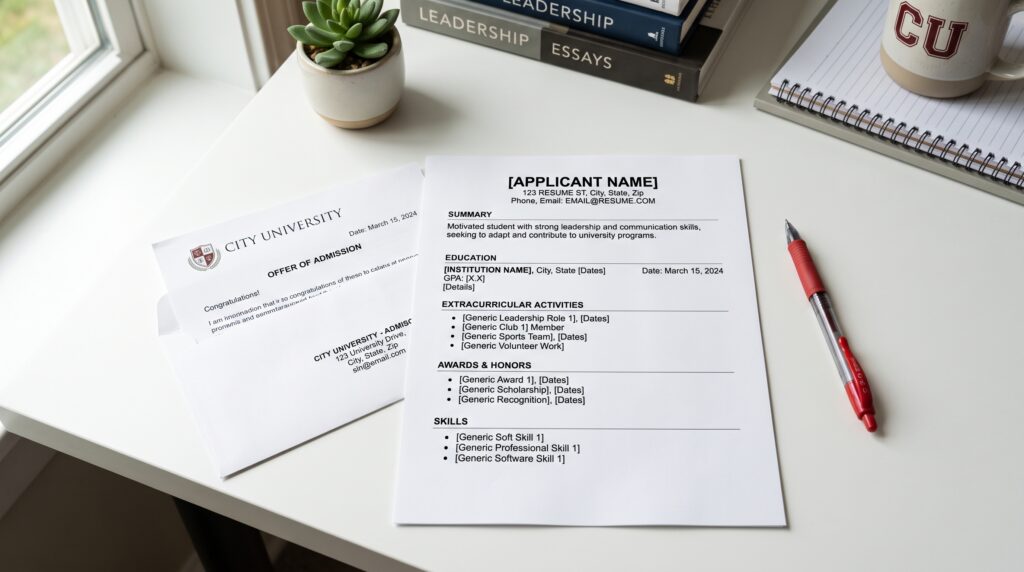
What to Put on a Resume for Scholarship — Section by Section
Every strong scholarship resume contains the same seven sections in the same order. Here is what goes in each one:
| Detail | Information |
| 1. Contact Information | Full name, professional email address, phone number, city and country. Do not include your photo, age, religion, or marital status unless specifically requested by the scholarship. |
| 2. Scholarship Resume Objective | 2 to 3 sentences tailored to this specific scholarship’s mission. Not a generic objective — see the next section for examples. |
| 3. Education | All post-secondary institutions attended, listed in reverse chronological order. Include: institution name, degree, major, GPA (if 3.0+ or equivalent), graduation year, and any academic honours. For students still enrolled, list expected graduation date. |
| 4. Academic Achievements and Awards | Dean’s list, academic prizes, gold medals, national exam rankings, merit certificates, scholarships previously received. Quantify where possible: ‘Ranked 3rd in national engineering examination, 2024.’ |
| 5. Work and Research Experience | Relevant internships, research assistantships, laboratory positions, or employment. Use reverse chronological order. Include the organisation, your role, dates, and 1 to 2 bullet points describing your contribution using action verbs and numbers. |
| 6. Extracurricular Activities and Leadership | Student government, clubs, sports teams, cultural organisations, debate teams. Include any leadership positions held. Scholarship committees specifically look for evidence of initiative and community engagement beyond the classroom. |
| 7. Volunteer and Community Service | Any formal or informal community service, NGO involvement, tutoring, mentorship programmes, or civic engagement. For scholarships like Chevening and AAUW, community service is a primary selection criterion — not an afterthought. |
| 8. Skills and Languages | Technical skills, software proficiency, research methods relevant to your field. Language proficiency with level (e.g., IELTS 7.0, French B2, Arabic native). Keep this concise and relevant. |
| 9. Publications / Research (if applicable) | Include any co-authored papers, conference presentations, or thesis work. Even a submitted or under-review paper is worth listing — note its status clearly. |
Scholarship Resume Objective — How to Write One With Examples
The scholarship resume objective is 2 to 3 sentences at the top of your resume that directly connect your background to the specific scholarship’s mission and goals. Most scholarship resumes either skip this section or include a generic objective that could apply to any programme. Neither approach is competitive.
The formula for an effective scholarship objective: [Who you are + your strongest credential] + [What you want to study / research] + [Why it connects to the scholarship’s mission].
| Scholarship Resume Objective Examples: For Chevening Scholarship: Dedicated public health professional with 4 years of experience in maternal health programme implementation in rural Pakistan, seeking to pursue a Master’s in Global Health Policy at the University of Edinburgh. Committed to returning to Pakistan to apply evidence-based policy solutions to Pakistan’s maternal mortality crisis — the core mission of the Chevening leadership programme. For DAAD Scholarship: Environmental engineering graduate (GPA 3.8/4.0, University of Lagos) with two published papers in wastewater management, applying for a DAAD Research Grant to pursue doctoral research at TU Munich under Professor [Name]’s environmental systems group. Research focus: developing low-cost wastewater treatment models applicable to Sub-Saharan African urban settings. For CSC Chinese Government Scholarship: Computer science graduate from Lahore University of Management Sciences (CGPA 3.7/4.0) with a research background in machine learning, seeking a Master’s in Artificial Intelligence at Tsinghua University through the CSC scholarship programme. Aim to contribute to AI development capacity building in Pakistan upon return. |
| 📌 Tailor Your Objective to Every Single Scholarship The scholarship resume objective is the one section you must rewrite for each application. The scholarship name, the specific university or programme, and the mission connection must be unique to each resume you submit. Sending a resume with a generic objective — or one mentioning a different scholarship — signals that the application is not serious. |
Academic CV for Scholarship — When to Use a CV Instead of a Resume
A scholarship cv — specifically an academic CV for scholarship — is different from a resume. Understanding when to use each one matters because submitting the wrong format can make your application look inappropriate for the programme level.
| Use a Resume (1 page) | Use an Academic CV (2–4 pages) | How to Tell Which One |
| Undergraduate scholarships | PhD / Postdoctoral fellowships | Check the scholarship guidelines — ‘resume’ vs ‘CV’ vs ‘academic CV’ |
| Taught Master’s scholarships (Chevening, Commonwealth, GREAT) | Research-based Master’s or PhD (DAAD Research Grant, Humboldt, Gates Cambridge) | PhD and research fellowships almost always require a full academic CV |
| Foundation and community scholarships | Academic grants and research fellowships | If the scholarship requires a research proposal, it requires a CV |
| Applications with 1-page document limits | Applications with no page limit specified | When no limit is stated for a research award, default to full academic CV |
A cv for scholarship application at the PhD or postdoctoral level should include — beyond the sections above — a full list of publications (conference papers, journal articles, book chapters), research projects and grants received, teaching experience, professional memberships, conference presentations, and academic references. This can extend to 3 or 4 pages for experienced researchers. For an undergraduate or taught Master’s scholarship, a one-page resume is always the correct format.
Scholarship Resume Tips — How to Make Your Resume Stand Out for Scholarships
These are the specific scholarship resume tips that separate competitive applications from mediocre ones. They come from what scholarship committees — the people who actually read and score these documents — consistently say determines whether a resume stands out or blends in.
- Quantify every achievement. ‘Tutored students’ is weak. ‘Tutored 24 first-year students in mathematics over two semesters, of whom 19 achieved passing marks after previously failing’ is strong. Every bullet point in your experience, activities, and service sections should contain a number — the number of people impacted, percentage improvement, duration, or scale of the activity.
- Use action verbs at the start of every bullet point. Led, initiated, developed, organised, researched, published, mentored, designed, implemented, raised, coordinated. Passive descriptions (‘was responsible for’) waste space and read weakly. Active verbs — especially ones that imply initiative and leadership — carry far more weight per word.
- Tailor the resume to the scholarship’s stated mission. Read the scholarship’s selection criteria and mission statement, identify the three to five qualities they explicitly value, and make sure those qualities appear — with evidence — somewhere in your resume. Chevening values networking and leadership. DAAD values research alignment. Commonwealth values development impact. Your resume must reflect the right priorities for each application.
- Put education first — always. For a scholarship resume, education is your primary credential. It goes at the top, immediately after your objective. Do not bury it under work experience as you would on a job resume. Include your GPA, any class rank information, and any honours or academic distinctions in the education section itself.
- Include community service even if it seems minor. Teaching younger students on weekends, volunteering at a local clinic, organising a neighbourhood clean-up — none of these are too small for a scholarship resume if they demonstrate genuine community commitment. Scholarship committees — particularly for programmes like Chevening, AAUW, and Commonwealth — actively look for service engagement beyond the classroom and the lab.
- Remove anything irrelevant and anything that takes up space without adding value. Hobbies like ‘reading’ and ‘travelling’ add nothing to a scholarship application. Generic skills like ‘Microsoft Office’ or ‘good communication skills’ are filler. Use every line of your one-page limit for evidence of achievement, leadership, and service — not generic self-descriptions that every applicant could claim.
Common Scholarship Resume Mistakes to Avoid
- Submitting the same resume to every scholarship: The objective, the activities highlighted, and the skills emphasised must be adjusted for each scholarship’s mission. A resume that works for Chevening will not work unchanged for DAAD.
- Listing responsibilities instead of achievements: ‘Member of the student council’ tells the committee nothing. ‘Secretary of the student council — organised 8 campus events attended by 500+ students and negotiated a 15% increase in the student welfare budget’ tells them everything.
- Including a photo unless required: For most international scholarships, a photo on a resume introduces potential bias and is not expected. Only include a photo if the scholarship application specifically requests one.
- Using a file name like ‘resume.pdf’ or ‘CV final 2.pdf’: Name your file ‘FirstName_LastName_ScholarshipName_CV.pdf’. This ensures the committee can identify your document when it is saved among hundreds of others.
- Submitting a resume with grammatical errors: Every error in your resume signals the same potential errors in your written academic work. Proofread it three times. Have someone else read it once. Use a grammar-checking tool. A scholarship resume is worth hours of careful review — it is a document that could determine whether you receive thousands of dollars in funding.
- Not listing GPA or academic standing: If your GPA is strong, include it. If you do not include it, committees assume it is not strong. For scholarships that list academic performance as a criterion — which is most of them — omitting your grades creates an information gap that works against you.
Frequently Asked Questions — Scholarship Resume and CV
Q1: How long should a scholarship resume be?
One page for undergraduate and taught Master’s scholarships — no exceptions. Scholarship selection committees review large volumes of applications and spend one minute or less scanning each resume. A two-page scholarship resume almost always contains content that should have been removed. Use the one-page constraint as an editorial discipline: include only the content that directly supports your case for this specific scholarship.
Q2: Should I include GPA on my scholarship resume?
Yes — always, if it is 3.0/4.0 or above, or the equivalent in your country’s grading system. For scholarships like DAAD (which requires the top third of the graduating class) or HEC Commonwealth (which requires a first-class result), your GPA is a primary eligibility criterion. Including it prominently — in the education section, immediately after your degree — makes it easy for the committee to confirm your eligibility at a glance. If your grading system uses percentages or letter grades, include a brief conversion note: for example, ‘85% (equivalent to GPA 3.7/4.0)’.
Q3: What is the difference between a scholarship resume and an academic CV?
A scholarship resume is a one-page document summarising your academic achievements, activities, leadership, and community service — used for undergraduate, taught Master’s, and most foundation scholarships. An academic CV is a longer document (2 to 4 pages) that includes a full list of publications, research projects, grants received, teaching experience, conference presentations, and professional memberships — used for PhD fellowships, research grants, and postdoctoral awards such as DAAD Research Grants, the Humboldt Fellowship, and Gates Cambridge. Check each scholarship’s application guidelines to determine which format is expected.
Q4: Can I use the same scholarship resume for multiple applications?
You can use the same base document — but you must customise the objective section and adjust the highlighted activities for each scholarship. The factual content (education, grades, employment dates, activity descriptions) stays the same. The objective, the order in which activities are listed, and the specific language used to describe achievements should be adjusted to align with each scholarship’s stated mission and selection criteria. Submitting an identical resume with no customisation to multiple programmes consistently produces worse results than a tailored version.
Q5: What activities should I include on a scholarship resume with no work experience?
Students with limited or no formal work experience should focus on academic achievements, extracurricular involvement, volunteer work, and any research or academic projects completed during their studies. Leadership positions within student organisations, community tutoring, participation in academic competitions, peer mentoring, and sports team involvement all count. The key is to describe each activity with specific details and where possible quantified impact — not just a title. ‘Vice President, Engineering Students Society (2024–2025) — organised 3 career fairs connecting 400+ students with 25 industry employers’ is significantly stronger than simply ‘VP, Engineering Students Society’.
Q6: Should I write a scholarship resume in English even if the scholarship is in another country?
For international scholarships administered in English — including Chevening, Commonwealth, DAAD (English-taught programmes), Gates Cambridge, Rhodes, Australia Awards, and CSC for English-track programmes — submit your resume in English. For scholarships in non-English countries where instruction is in another language (e.g., DAAD German-taught programmes, French government scholarships), submitting a version in the relevant language alongside an English version is generally appropriate. Always check the scholarship’s specific application guidance — most official application portals specify the required language for supporting documents.
Conclusion
A scholarship resume is not a job resume with a different heading. It is a one-page academic and personal record, specifically structured to show a selection committee why you deserve their award. Every section — the objective, the education listing, the activities, the volunteer work — must be tailored to the specific scholarship’s mission and selection criteria.
The students who win competitive scholarships consistently produce resumes that are specific, quantified, and tailored — not generic. They include their GPA, list their community service with numbers, write an objective that names the scholarship by name and connects their background to its mission, and keep the whole document to exactly one clean, proofread page. This is not difficult. It is a matter of knowing the standard — which this guide has laid out — and applying it carefully before every application deadline.
Visit studytribune.com for complete guides to the world’s leading fully funded scholarships, recommendation letter templates, and professor outreach guides — all the documents you need alongside your scholarship resume to submit a complete, competitive application.