
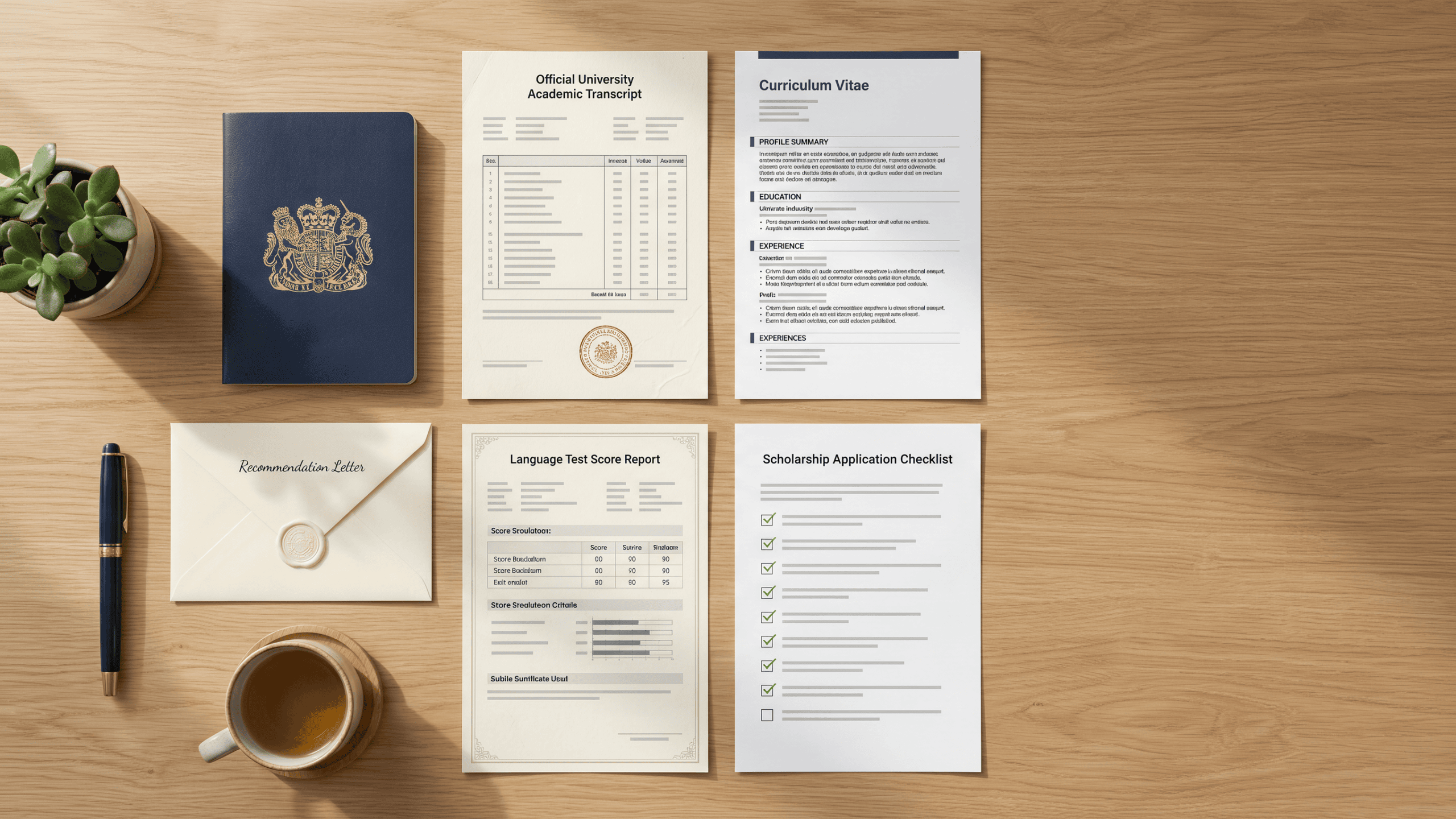
cholarship application documents decide whether a selection committee ever gets to your story. A missing stamp, a name spelled two different ways, or a recommendation letter that arrives late can push a strong file to the bottom of the pile before anyone reads it properly.
This guide covers all the scholarship application documents international students are asked for when applying for scholarships abroad: what each one proves, who issues it, how long it tends to take, and where applicants usually go wrong. Every section links to a detailed guide with samples and templates, and the checklist at the end gives you one list to build your file from.
Requirements change by scholarship and by year. Use this page as your master checklist of scholarship application documents, then confirm every item against the official call of the scholarship you are applying to, such as the Holland Scholarship.
Scholarship Application Documents at a Glance
| Document | What it proves | Who provides it | Start preparing |
|---|---|---|---|
| Recommendation letters | Your ability and character, vouched for by someone credible | Professor, supervisor or employer | 4 to 6 weeks before the deadline |
| Personal statement, SOP or motivation letter | Your goals and why you fit | You | 3 to 4 weeks of drafting and revision |
| CV or resume | Your academic and work history | You | About a week |
| English proficiency proof | Language ability | Test centre or your university (MOI letter) | Test booking can take weeks |
| Transcripts and degree certificate | Your academic record | Your university | Several weeks, longer with attestation |
| Attestation, apostille, translation | Official recognition of those documents | Government office or certified translator | Several weeks |
| Financial proof or sponsor letter | You can cover costs the scholarship does not | Bank or sponsor | 1 to 2 weeks |
| Health insurance proof | You will be covered abroad | Insurer | A few days |
| Research proposal or study plan | Your academic plan | You | 3 to 6 weeks |
| Passport, photos, ID | Identity | Passport office, photo studio | Check passport expiry now |
| Police clearance, medical certificate, NOC | Eligibility for visa and enrolment | Police, clinic, employer | Often after selection, but slow |
The timings above are working estimates, not official figures. Offices in different countries move at different speeds, so plan for the slow end with your scholarship application documents.
Table of Contents
1. Recommendation Letters
Of all scholarship application documents, recommendation letters are the ones you cannot write yourself. Committees use them to check the claims in your statement against someone else’s word. A letter that calls you “hardworking and intelligent” adds nothing. A letter that describes a project you led, a grade you earned, or a problem you solved is evidence.
Who to ask: a professor who taught or supervised you, or a manager who has seen your work first-hand. A senior name who barely knows you writes a weak letter, and committees can tell.
How to ask: send your recommender a short packet with your CV, a draft of your personal statement, the scholarship name, the deadline, and the exact submission instructions. Many portals email the recommender a direct upload link, so confirm which email address they will actually use. Some systems expect an institutional address.
Common mistakes: asking less than a month before the deadline, using one generic letter for every scholarship, and not checking how many letters the call requires. It is usually between one and three.
For formats, samples and a request email you can adapt, read the full guide: Recommendation Letter for Scholarship: Sample, Example, Template and Format.
2. Personal Statement, SOP and Motivation Letter
Scholarship application documents of this type go by three names that scholarships use loosely, so follow the prompt in the portal rather than the label. As a working rule, a personal statement tells your story and motivation, a statement of purpose (SOP) focuses on your academic or professional goals and plan, and a motivation letter explains why you want this particular programme and this particular scholarship.
What works: open with a specific moment, not a general claim about passion. Then connect where you started, what you have done, what you want next, and why this scholarship is the route there. Stay inside the word limit.
What fails: reusing one statement everywhere. Committees read a lot of files, and a statement that could be sent to any scholarship reads like it was. Keep a strong base version, then rewrite the opening and the “why this program” section for each application.
Go deeper: Personal Statement for Scholarship: Samples and Writing Guide.
3. CV or Resume
Your CV is the shortest of the scholarship application documents, and most scholarships want one to two pages. Some European programmes ask for the Europass format, so check the call before you design anything.
Lead with education, then research or publications, work experience, volunteering, awards and skills. Use one date format throughout, keep the language plain, and cut anything that does not support your application. Leave out a photo and details like marital status unless the scholarship asks for them. Export to PDF and name the file properly.
Go deeper: Scholarship CV: Templates and Examples.
4. English Proficiency Proof
Language proof is one of the scholarship application documents with the longest lead time. The usual options are IELTS, TOEFL, Duolingo English Test and PTE. Scores are generally accepted for about two years, so check the validity window against the deadline, not against the date you booked.
Some applicants can use a Medium of Instruction (MOI) letter instead, issued by the university where they studied. A good MOI letter names you, your degree and your study dates, and states that English was the medium of instruction. It should be signed and stamped. Ask early, because registrar offices are rarely fast.
One point many applicants miss: a university waiving its English requirement does not mean the scholarship waives it too. The scholarship sets its own rule, so read it separately.
If you plan to sit IELTS, you can book through British Council. This page contains affiliate links. If you use one, we may earn a commission at no extra cost to you.
Go deeper: English Proficiency and MOI Letter Guide.
5. Transcripts, Degree Certificates and Attestation
These scholarship application documents depend most on other offices, so ask early. Request official transcripts, not student copies. Some scholarships want them in a sealed envelope or sent directly by your university, so never open anything marked sealed. If you have not graduated yet, ask for an enrolment letter or provisional result certificate and check whether the scholarship accepts it.
Attestation, legalization and apostille are different processes, and which one applies depends on your country and the destination country. Many applications only need clear scans at first, with attested copies required at the visa or enrolment stage. Check the call. If a document is not in the programme’s language, you will need a certified translation.
Insider tip: when you visit the registrar, ask for several certified copies at once. You will use them again.
Go deeper: Academic Documents, Attestation and Apostille Guide.
6. Financial and Insurance Documents
Financial papers are the scholarship application documents applicants forget until the visa stage. Fully funded scholarships often ask for no financial proof, but partial scholarships and the visa stage usually do. Typical items are recent bank statements, a sponsor letter with the sponsor’s own statements, or an affidavit of support. Use the exact format the university or embassy asks for.
Health insurance is a separate requirement. Some scholarships and universities want proof of cover before you travel, and not every plan is accepted. Read the requirement first, then compare plans. We cover this in Scholarship Travel Insurance Requirements. If you are considering SafetyWing, you can look at plans through this link, but confirm with your scholarship provider that the plan is accepted before you buy.
Go deeper: Financial Documents for Scholarships.
7. Research Proposal, Study Plan and Portfolio
Research-based master’s and PhD applications add extra scholarship application documents, starting with a research proposal: a clear question, short background, method and a realistic timeline. Some scholarships, such as Chinese government scholarships, ask for a study plan instead. Creative fields add a portfolio, and some programmes request a writing sample.
Before writing a proposal, email a possible supervisor. A short, specific message that shows you have read their work gets more replies than a template sent to fifty people, and some programmes expect a supervisor’s support before you apply.
Go deeper: Research Proposal and Study Plan Guide.
8. Identity and Compliance Documents
Identity papers are scholarship application documents you cannot rush, so start with your passport. Many countries expect it to stay valid for months after your programme begins, so check the expiry date now. Next come passport photos (follow each portal’s size and background rules exactly), a birth certificate, national ID, police clearance certificate, medical certificate, and a no objection certificate (NOC) from your employer if you are working.
Most of the later items are requested after selection or at the visa stage, but they come from government offices and clinics, so they take time. Know what is required, and start the slow ones early.
Go deeper: Identity and Compliance Documents Guide.
How to Prepare Your Scholarship Application Documents Step by Step
Work through these seven steps from the day you find a scholarship to the day you submit.
- List what the call asks for. Open the official announcement and write down every required item, the deadline, and any format or file-size rules. Your list of scholarship application documents should come from the scholarship itself, not from this page alone.
- Sort by lead time. Mark the scholarship application documents that depend on other people or offices: the language test, transcripts, attestation and recommendation letters. These go first.
- Request the slow items. Book your language test, ask the registrar for official transcripts, and send each recommender their packet. These scholarship application documents can take weeks, so do not wait.
- Draft the writing. Write your CV first, then the personal statement, SOP or motivation letter, and the research proposal if the call asks for one. Tailor each one to the scholarship.
- Collect the supporting papers. Scan your passport and photos, and gather financial and insurance proof if required. Check that your name matches everywhere.
- Review and organize. Open every scan at full size, rename the files, and ask someone you trust to read your statement. Keep all your scholarship application documents in one master folder.
- Submit early and keep proof. Upload two to three days before the deadline, save the confirmation, and keep a copy of everything you submitted.
How to Organize Your Scholarship Application Documents
A messy folder costs applicants more than they expect. Set up one master folder for your scholarship application documents and reuse it for every application.
- Folder structure: 01 Identity, 02 Academic, 03 Language, 04 Recommendations, 05 Statements and CV, 06 Financial, 07 Submitted (one subfolder per scholarship).
- File names: Firstname-Lastname_Document-Type_Scholarship.pdf, so you never upload the wrong version.
- Name consistency: write your name exactly as it appears in your passport on every form and document. If a certificate spells it differently, ask the issuing office for a correction or an official name-variation statement, and ask the scholarship contact which they accept.
- Scans: PDF, readable at full size, stamps and signatures fully visible, within the portal’s file-size limit.
- Tracker: one spreadsheet with document, status, deadline and date submitted.
When to Start Preparing Scholarship Application Documents: A Simple Timeline
| When | What to do |
|---|---|
| 6 months or more before the deadline | Book your language test, request transcripts, start attestation if needed, shortlist recommenders, read the official call |
| 4 to 5 months | Draft your personal statement and CV, send recommenders your packet |
| 2 to 3 months | Revise the statement with someone who will be honest, write the research proposal, follow up on letters |
| 1 month | Gather financial papers, scan everything, practise on the application portal |
| Final week | Submit two to three days early and save the confirmation |
Common Mistakes With Scholarship Application Documents
- Your name is spelled differently across your passport, certificates and forms.
- You followed the university’s requirements and missed the scholarship’s own rules.
- Scans are cropped, blurry or cut off at the stamp.
- You went over the file-size or word limit.
- A recommender was asked too late and the letter missed the deadline.
- You uploaded unofficial or uncertified copies where official ones were required.
- You waited until the last hour and the portal slowed down or crashed.
- You kept no copy of what you submitted.
Scholarship Application Documents Checklist
Copy this list of scholarship application documents into your tracker and tick items off as you collect them.
Identity
- Passport, valid well beyond your programme start date
- Passport-size photos to the portal’s specification
- National ID or birth certificate, if requested
Academic
- Official transcripts
- Degree certificate, or provisional certificate if you have not graduated
- Attestation or apostille, if required at this stage
- Certified translations, if required
Language
- IELTS, TOEFL, Duolingo or PTE score report, or an MOI letter if the scholarship accepts one
Writing
- CV
- Personal statement, SOP or motivation letter
- Research proposal or study plan, if required
- Portfolio or writing sample, if required
Recommendations
- Recommenders confirmed
- Packet sent with deadline and instructions
- Letters submitted and confirmed
Financial and insurance
- Bank statements or sponsor letter, if required
- Health insurance proof, if required
Later stage, often after selection
- Police clearance certificate
- Medical certificate
- No objection certificate (NOC) from employer
Before you submit
- Name matches your passport everywhere
- Every scan opened and checked at full size
- Submission confirmation saved
[Download the printable checklist (PDF): add the email signup button here]
Frequently Asked Questions
What scholarship application documents are required to study abroad?
The core scholarship application documents are a CV, a personal statement or motivation letter, one to three recommendation letters, academic transcripts and degree certificates, proof of English proficiency, and a copy of your passport. Financial proof, a research proposal or study plan, and compliance documents such as police clearance are common for some scholarships or for later stages.
How many recommendation letters do I need?
It depends on the scholarship, and it is usually between one and three. Read the official call, because some portals send the request directly to your referee.
Do I need an apostille for scholarship application documents?
Not always at the application stage. Many scholarships accept clear scans first and ask for attested or apostilled copies at the visa or enrolment stage. Check the call and the destination country’s rules.
Can I use the same personal statement for different scholarships?
Keep one strong base version, but rewrite the opening and the section on why this programme for each application. Generic statements are easy to spot.
Can an MOI letter replace IELTS?
Sometimes. The scholarship provider decides, and a university’s English waiver does not automatically count. Confirm it in the scholarship rules.
When should I start preparing scholarship application documents?
Four to six months before the deadline is a comfortable window, because language tests, attestation and recommendation letters all depend on other people.
What to Do Next
Pick the scholarship application documents that will take longest and start there. For most applicants that is the language test, attestation, or the recommendation letters. Then work through the guides above, one for each of the scholarship application documents you still need: recommendation letters, personal statements, CV and English proof.
Government Office or Certified Translator