

Last updated: June 2026 · Reading time: 22 minutes · Study Tribune Scholarships Desk
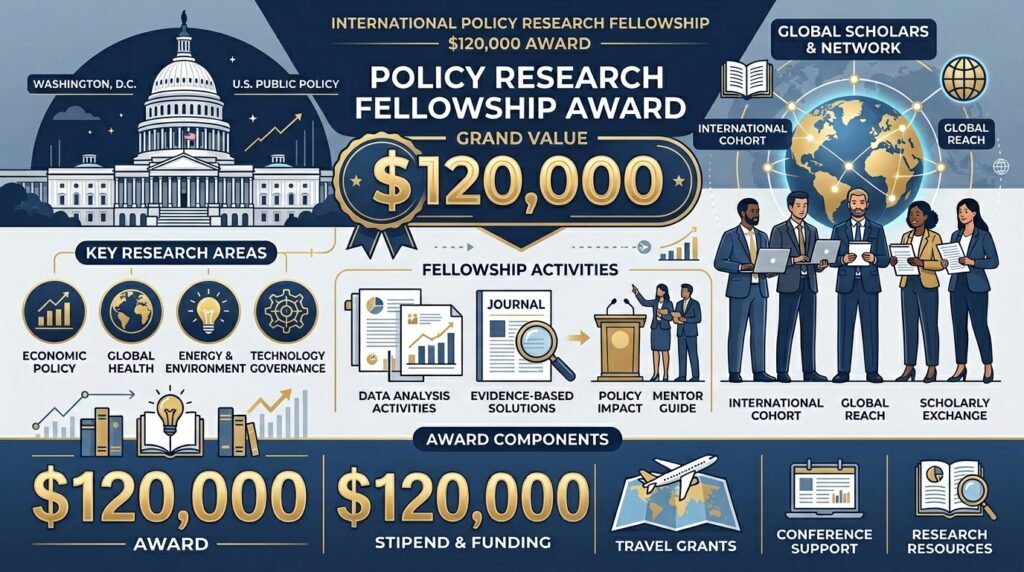
The Woodrow Wilson Center Fellowship is one of the most prestigious and financially substantial research fellowships available to scholars and policy professionals anywhere in the world. Established by an Act of the United States Congress in 1968 as the official living memorial to President Woodrow Wilson, the Center has spent more than five decades bridging the divide between the world of academic ideas and the world of policy action — and its fellowship programme is the primary vehicle through which it does so. For the 2026-2027 cycle, the Wilson Center offers a $10,000 monthly stipend over twelve months, totalling $120,000, to scholars, practitioners, journalists, and public intellectuals selected to conduct policy-relevant research connecting with Washington’s policymaking community.
In this comprehensive guide, Study Tribune covers everything you need to know about the Woodrow Wilson Center Fellowship 2026-2027: the updated funding structure, complete eligibility requirements, the four scholarship pillars that define competitive projects, the full document and application checklist, the selection criteria, and the strategies that distinguish successful proposals from the thousands that do not advance. Whether you are an academic in Pakistan conducting research on strategic competition, a journalist in Nigeria investigating economic statecraft, or a government practitioner in Egypt working on regional foreign policy — this guide is written for you.
Study Tribune only lists verified, officially active fellowship programmes with information drawn directly from official sources. The Wilson Center Fellowship has been operating continuously since 1968 and the 2027-2028 application cycle is expected to open in summer 2026. Bookmark this page — it is updated as new cycles open. Subscribe to Study Tribune’s free newsletter to receive deadline alerts before opportunities close.
What Is the Woodrow Wilson Center Fellowship?
The Woodrow Wilson International Center for Scholars is not a university and not a traditional think tank. It occupies a unique space in Washington’s intellectual landscape as the only institution established by Congress specifically to connect the rigour of academic scholarship with the practical demands of public policy. Its location — at One Woodrow Wilson Plaza inside the Ronald Reagan Building and International Trade Center, at 1300 Pennsylvania Avenue NW, Washington D.C. — places it physically between the Capitol and the White House, a symbolic positioning that reflects its institutional mission.
The Center’s fellowship programme, its flagship initiative, invites a new cohort of scholars every year to conduct independent research while engaging actively with Washington policymakers, government officials, members of Congress, and the broader policy community. The fellowship is not a lecture or seminar programme — it is a research residency built around a single, substantial research project that each fellow proposes and delivers during their tenure. For the 2026-2027 cohort, the fellowship commenced June 1, 2026 and runs through May 30, 2027, with fellows working remotely for the majority of their tenure and travelling to Washington D.C. at the start and end of the programme — both trips fully funded by the Center.
What makes the Wilson Center Fellowship genuinely distinctive — and genuinely valuable — is the combination of serious financial support, institutional credibility at the highest level of Washington policy life, and the freedom to pursue independent research without the institutional obligations that characterise most academic or government positions. A Wilson Center Fellowship on your CV signals to every employer, university, and funding body in the world that your work has been vetted by one of the most demanding and prestigious selection processes in international policy scholarship.
Woodrow Wilson Center Fellowship 2026-2027: Quick Reference Summary
| Detail | Information |
| Full name | Woodrow Wilson International Center for Scholars Research Fellowship |
| Established by | U.S. Congress, 1968 (official national memorial to President Wilson) |
| Fellowship location | One Woodrow Wilson Plaza, 1300 Pennsylvania Ave. NW, Washington, DC 20004 |
| Fellowship format | Remote work throughout tenure + two funded trips to Washington D.C. |
| Fellowship year (2026-27) | June 1, 2026 – May 30, 2027 |
| Monthly stipend | $10,000 per month |
| Total stipend (12 months) | $120,000 |
| Application deadline (2026-27) | January 16, 2026 at 11:59 PM ET — CLOSED |
| Next cycle (2027-28) | Expected to open: Summer 2026 (check wilsoncenter.org) |
| Notification | Early April (following application deadline) |
| Degree requirement | PhD or J.D. (academic applicants); equivalent professional achievement (practitioners) |
| Open to | All nationalities — citizens and permanent residents of all countries |
| Contact | fellowships@wilsoncenter.org |
| Official website | wilsoncenter.org/fellowship-application-guidelines |
What Does the Woodrow Wilson Center Fellowship Cover?
The Wilson Center Fellowship is classified as a fully funded research fellowship, but understanding exactly what it covers — and what it does not — is essential for financial planning before you apply.
What the Fellowship Provides
| Benefit | What the Wilson Center Provides |
| Monthly stipend | $10,000 per month for the full twelve-month fellowship tenure |
| Total stipend value | $120,000 — paid directly to the fellow on a monthly basis |
| Washington D.C. trips | Two fully funded trips: programme start meeting and closing meeting. Travel and lodging arranged by the Wilson Center. |
| Research support | Access to Wilson Center researchers, library resources, policy networks, and Washington expert community |
| Institutional affiliation | Official Wilson Center fellowship title — one of the most recognised credentials in global policy scholarship |
| Publication support | Assistance translating academic research into accessible, policy-relevant outputs for broader audiences |
| Policy engagement | Direct access to Congressional briefings, policy discussions, public seminars, and Washington expert networks |
What the Fellowship Does Not Cover
| Item | Fellow’s Responsibility |
| Health insurance | Fellows are personally responsible for arranging and funding their own health coverage |
| Personal travel | Short-term research trips a fellow wishes to take during tenure are not funded by the Center |
| Tuition | The fellowship is a research programme, not an academic degree — no tuition is involved |
| Dependent support | No specific dependent or family allowance is provided |
| 💡 Is the Wilson Center Fellowship Fully Funded? Yes — with important clarity. The $120,000 stipend is paid directly to the fellow and is designed to cover living expenses for the full year of research. Fellows are responsible for their own health insurance and personal travel costs, which are not reimbursed separately. Unlike university scholarships that pay tuition to an institution, the Wilson Center fellowship is a research stipend — the entire $120,000 is yours to allocate toward living, research, and professional costs as you determine. This makes it one of the highest-value fully paid research fellowships available globally. |
The Four Scholarship Pillars: What Research the Wilson Center Funds
This is the section most competing guides omit entirely — and it is the most important section for deciding whether to apply. The Wilson Center does not fund all research equally. For the 2026-2027 cycle and expected future cycles, the Center has defined four specific scholarship pillars that all funded projects must address. Understanding these pillars is not optional preparation — it is the foundational requirement that determines whether your application can advance.
Your research project must focus on at least one of the following four pillars:
Pillar 1: Strategic Competition
Research examining the dynamics of strategic competition between major world powers, with particular focus on issues relevant to United States foreign policy. This includes: geopolitical competition in the Indo-Pacific, Arctic, or other contested regions; military balance and deterrence; alliance dynamics and multilateral security frameworks; nuclear strategy and arms control; and the competition for influence in developing regions. Scholars working on US-China relations, NATO dynamics, or emerging power rivalry will find their projects naturally aligned with this pillar.
Pillar 2: Economic Statecraft
Research examining the intersection of economics and foreign policy — how states use economic instruments to achieve strategic objectives. This includes: sanctions design and effectiveness; trade policy as a diplomatic instrument; investment screening and economic security; supply chain vulnerabilities and reshoring; development finance and geoeconomics; financial systems and dollar dominance; and the economic dimensions of great-power competition. Scholars from economics, political economy, and international business backgrounds will find this pillar particularly relevant.
Pillar 3: Technology and Innovation
Research examining how emerging technologies are reshaping international relations, security, and governance. This includes: artificial intelligence and its policy implications; cyber security and offensive cyber capabilities; semiconductor supply chains and technology competition; emerging weapons systems and the future of warfare; digital governance and data sovereignty; biotechnology and biosecurity; and the governance of transformative technologies in a multipolar world. This is the most rapidly growing pillar and one where scholars with technical backgrounds combined with policy expertise are particularly competitive.
Pillar 4: Regional Scholarship
Research focused on specific world regions that are significant to US foreign policy concerns. The Wilson Center has deep regional expertise in the Americas, Europe, Asia, the Middle East, Africa, and the former Soviet space. Regional scholarship projects should address a problem or dynamic in one or more of these regions that has clear policy implications for US foreign policy or for international stability. Area studies scholars, regional specialists, and practitioners with deep expertise in a specific country or region will find this pillar accommodating their strongest work.
| ⚠️ Critical Project Restrictions The following types of projects are explicitly not funded by the Wilson Center: doctoral dissertations or their rewriting and completion; projects in the visual arts, dance, or musical composition; advocacy projects that promote a specific political position. Projects must be nonpartisan in nature — the Center is committed to evidence-based scholarship that seeks to inform policy debate, not advance a particular political agenda. Any project that could reasonably be characterised as advocacy for a specific viewpoint will not be considered. |
Woodrow Wilson Center Fellowship Eligibility — Who Can Apply?
The Wilson Center Fellowship is intentionally broad in its eligibility criteria. The Center explicitly invites four different types of applicants, recognising that policy-relevant scholarship takes many forms and comes from many professional backgrounds. Before beginning your application, confirm that you meet the requirements in your relevant category.
The Four Eligible Applicant Profiles
1. Academic Scholars (PhD or J.D. holders)
Academic applicants must hold a PhD or a J.D. degree. The degree must be received — not merely expected — by the application deadline. Additionally, academic applicants must demonstrate scholarly achievement through publications beyond their doctoral dissertation. A dissertation alone is not sufficient evidence of scholarly achievement for the Wilson Center’s purposes. You must show that you have produced peer-reviewed publications, book chapters, or other scholarly outputs that demonstrate your ability to conduct and complete independent research of publishable quality.
2. Practitioners and Policymakers
Practitioners — including current or former government officials, diplomats, international organisation professionals, and policy practitioners — are eligible on the basis of professional achievement equivalent to the academic standard. The Center does not require a PhD from practitioner applicants, but does require evidence of a career in which you have produced policy work, analysis, or decisions of equivalent depth and significance. Senior practitioners with significant government or international organisation experience are competitive applicants in this category.
3. Journalists and Public Intellectuals
Journalists and public intellectuals with a track record of sustained, substantive work on foreign policy issues are eligible. The Center recognises that some of the most important policy-relevant knowledge production occurs outside traditional academic and government channels. Journalists applying for the fellowship should have a body of work that demonstrates both expertise in their chosen research area and the capacity to produce policy-relevant analysis rather than conventional journalistic reporting during their fellowship tenure.
4. Professionals from Law, Business, and Other Fields
The Wilson Center explicitly welcomes men and women with outstanding capabilities and experience from business, law, and other professional backgrounds, provided they can demonstrate relevance to the Center’s mission and propose a research project that fits within one of the four scholarship pillars. The common thread across all eligible applicant profiles is the capacity to propose and deliver a specific, substantial, policy-relevant research project during the fellowship year.
Nationality and Visa Requirements
- Nationality: Open to citizens and permanent residents of all countries worldwide — there are no country restrictions and no nationality quotas
- Non-US applicants: Must hold a valid passport and must be able to obtain a J-1 visa, even if currently present in the United States under another visa status
- Current US residents: Eligible to apply regardless of current immigration status, provided you can obtain a J-1 visa
- Age: There is no age limit. The Center requires evidence of ability to carry out the proposed project — not evidence of youth or early career status
Language Requirements
- All application materials must be submitted in English
- All fellowship activities — presentations, policy briefings, interactions with Washington policymakers — are conducted in English
- No formal language test (TOEFL, IELTS) is required, but your application materials — particularly your project proposal — must demonstrate sophisticated written English proficiency
- Applicants whose first language is not English should note that the quality of written English in the project proposal directly signals your capacity to produce accessible, readable policy outputs during the fellowship
| ✅ Quick Eligibility Check for Study Tribune Readers If you are reading this from Pakistan, Nigeria, Egypt, Bangladesh, Kenya, India, Indonesia, or any other country: the Wilson Center Fellowship is open to you with no nationality restrictions. You need a PhD or J.D. (if applying as an academic), publications beyond your dissertation, a project that fits one of the four pillars, and the ability to obtain a J-1 visa. If you are a senior government practitioner, journalist, or professional without a PhD, you can apply on the basis of professional achievement — the fellowship is not exclusively for academics. |
Required Documents — Complete Application Checklist
The Wilson Center’s application is structured around a small number of components, each of which carries significant weight. Unlike scholarship programmes that request ten or fifteen documents, the Wilson Center focuses its evaluation on quality of writing and quality of ideas. There are no certified translations required and no degree certificates to upload. What matters is the intellectual quality of your project proposal and the strength of your supporting materials.
Core Application Components
- Online application form — completed through the official Wilson Center fellowship portal at wilsoncenter.org. Create your account and begin completing the form as soon as the portal opens for the 2027-2028 cycle (expected summer 2026).
- Project proposal — the heart of your application. See the dedicated section below for the full structure and strategy. Must be policy-relevant, nonpartisan, and fit within at least one of the four scholarship pillars.
- Curriculum Vitae (CV) — maximum 3 pages using 12-point font. Must include all publications with exact titles, publisher names, dates of publication, and status of forthcoming publications. The Center explicitly allows explanation of lapses and opportunities offered but not taken — your CV does not need to be uninterrupted to be competitive.
- Two letters of recommendation — submitted directly online by recommenders through the Wilson Center portal. Letters must be submitted by the application deadline — recommenders cannot submit after the portal closes. Contact recommenders at least six to eight weeks before the deadline.
- Conflict of interest disclosure — a written response (maximum 200 words) disclosing any potential conflicts of interest with the Wilson Center, and whether you intend to hold any other positions or affiliations during the fellowship tenure and how you will balance those responsibilities.
What the Wilson Center Does Not Require
The following are not required and should not be submitted: official degree certificates, certified academic transcripts, TOEFL or IELTS score reports, financial statements, proof of admission to a US institution, or immigration documentation. The Wilson Center’s evaluation focuses entirely on the quality of your proposed project, your track record of relevant work, and the strength of your letters of recommendation.
| ⚠️ Critical Note on Letters of Recommendation The Wilson Center requires exactly two letters of recommendation, submitted directly online by your recommenders before the deadline closes. Unlike academic scholarship programmes that may accept three or four letters, the Wilson Center is firm at two. Your recommenders must know your work — specifically the research project you are proposing — in sufficient depth to speak credibly about your capacity to complete it. Generic recommendation letters from senior figures who know you only superficially will score significantly lower than specific, detailed letters from colleagues who understand your research agenda and can speak to your track record of completing ambitious projects. Contact your recommenders at least eight weeks before the deadline. Confirm they have submitted at least one week before the closing date. |

Wilson Center Fellowship Application Timeline 2026-2027
The Wilson Center runs on a strict, publicly announced timeline. The 2026-2027 fellowship year is underway. The information below covers the closed 2026-2027 cycle for reference, and what to expect for the upcoming 2027-2028 cycle, which the Center has indicated will open in summer 2026.
| Date / Phase | What Happens |
| Summer 2026 (anticipated) | Wilson Center opens 2027-2028 application portal — check wilsoncenter.org and follow @TheWilsonCenter |
| Autumn 2026 (anticipated) | Application portal active — submit project proposal, CV, and conflict of interest disclosure; recommenders submit letters |
| Anticipated deadline (2027-28) | January 2027 (exact date TBC — the 2026-2027 deadline was January 16, 2026) |
| Review period | February–March (internal Wilson Center review + Selection Board review by external experts) |
| Notifications | Early April — all selected fellows notified. The Center does not accommodate requests for early notification. |
| Fellowship year begins | June 1 (2027-2028 cohort would begin June 1, 2027) |
| Washington D.C. trip 1 | Programme start meeting — travel and lodging arranged and funded by the Wilson Center |
| Work-in-Progress presentation | During fellowship tenure — each fellow delivers an internal presentation for feedback from Wilson Center staff and peers |
| Washington D.C. trip 2 | Closing meeting — travel and lodging arranged and funded by the Wilson Center |
| Fellowship year ends | May 30 |
| Final outputs | Completed research project (book manuscript, long-form articles, or policy briefing series) |
| 💡 For 2027-28 Applicants: Start Now The Wilson Center has confirmed the 2027-2028 cycle will open in summer 2026. The application that wins is rarely written in the weeks before the deadline — it is refined over months. Begin developing your research project proposal now: identify which of the four scholarship pillars it fits, define your research question with precision, and begin drafting the proposal narrative. Contact potential recommenders now to ensure they are available and briefed on your project well before the portal opens. |
How to Apply for the Woodrow Wilson Center Fellowship — Step by Step
The Wilson Center application process is leaner than most major fellowship programmes but significantly more demanding in the quality it expects from each component. There is no document certification, no transcript submission, and no language test — but the project proposal and CV are evaluated at a level of intellectual rigour that reflects the Center’s position as one of the world’s leading policy research institutions.
- Monitor wilsoncenter.org starting summer 2026. The Center has confirmed the 2027-2028 cycle information will be published in summer 2026. Set a browser bookmark and check weekly. Follow @TheWilsonCenter on social media for announcements. Subscribe to Study Tribune’s newsletter for deadline alerts.
- Identify your scholarship pillar. Before writing a single word of your proposal, confirm that your project fits within at least one of the four pillars: strategic competition, economic statecraft, technology and innovation, or regional scholarship. If your project does not clearly fit any pillar, it will not advance — regardless of its academic quality.
- Define your research question with precision. The project proposal is the heart of your application. The Wilson Center expects a research question that is: policy-relevant (directly informs decisions that policymakers face), fresh (involves new research not previously covered in your own or the field’s literature), and nonpartisan (does not advocate for a specific political position). A vague research question produces a weak proposal. A sharp, specific research question is the single most important indicator of a competitive application.
- Contact your two recommenders immediately. Aim to have both recommenders confirmed and briefed at least eight weeks before the anticipated deadline. Provide them with your CV, your draft project proposal, and a specific note explaining why you are pursuing the Wilson Center fellowship and what role your research plays in the Center’s mission. Recommenders who understand the Wilson Center’s specific criteria write more targeted and effective letters.
- Draft and revise your project proposal. Allocate at least four to six weeks of focused writing and revision for the proposal. Get feedback from colleagues who understand the policy relevance of your work — ideally people with experience in Washington policy circles or knowledge of the Center’s previous fellows and publications.
- Complete your CV to the Wilson Center’s specifications. Maximum three pages, 12-point font, all publications listed with full bibliographic detail. Do not omit publications — incomplete CVs signal disorganisation. If you have gaps or non-standard entries, the Center explicitly invites explanation.
- Write your conflict of interest disclosure. This is a maximum 200-word response to the question of potential conflicts and any other affiliations you intend to hold during the fellowship. Be transparent and specific. The Center’s evaluation is not automatically negative if you hold other affiliations — but it does require that you articulate clearly how you will balance them with fellowship expectations.
- Submit through the official Wilson Center portal before the deadline. The portal closes automatically at 11:59 PM ET on the deadline date. Do not wait until the final day. Ensure your recommenders have submitted their letters at least one week before the closing date.
How to Write a Winning Wilson Center Research Proposal
The project proposal is, in the Wilson Center’s own words, the heart of your application. Every other component of the application exists to support the proposal — the CV demonstrates you can deliver what you propose, and the letters of recommendation confirm that people who know your work believe you are capable of producing it. If your proposal is weak, no other element of your application can compensate.
The Wilson Center applies three primary evaluative criteria to proposals: the capabilities and achievements of the applicant and their propensity to accomplish the proposed project; the potential to actively contribute to the priorities and mission of the Center; and the scholarly quality and policy relevance of the proposed research. Every sentence of your proposal should be written with these three criteria in view.
What Makes a Wilson Center Proposal Competitive
1. Policy relevance that goes beyond academic impact
The Wilson Center is not a university. It is not looking for research that advances a theoretical debate within an academic discipline. It is looking for research that will directly inform the decisions that people in Washington — in Congress, in the executive branch, in international organisations — actually face. Your proposal must articulate not just what your research will find, but who in the policy world will use those findings and how. If you cannot name the type of policymaker who would read your output and the type of decision it would inform, your proposal is not yet policy-relevant enough for the Wilson Center.
2. Freshness in relation to both the field and your own prior work
The Center explicitly requires that projects involve fresh research — in terms of both the overall field and the author’s previous work. This is a double test. Your project must not merely replicate what other scholars have already done. But it must also not merely extend work you have previously published — the fellowship is designed to support new directions, not to fund the completion of work already substantially developed. If your proposal reads as a continuation of your dissertation or your most recent book, it is unlikely to satisfy the freshness criterion.
3. Transcending narrow disciplinary specialisation
The Center explicitly welcomes projects that transcend narrow specialties and methodological issues of interest only within a specific academic discipline. This does not mean interdisciplinary work for its own sake — it means that the research question and its implications must be legible and meaningful to people outside your specific subdiscipline. A proposal that only specialists in a narrow methodological tradition would find interesting is less competitive than one that draws on specialised expertise to address questions that policymakers, journalists, and engaged citizens can understand and care about.
4. A convincing case for completion
The proposal must convince the reviewer that there is something genuinely at stake with your inquiry and that your project will yield interesting results. This means: a clear statement of what the project will produce (a book manuscript, a series of long-form articles, a briefing roundtable series), a realistic timeline for completion within the fellowship year, and implicit or explicit evidence that you have the disciplinary expertise and prior research foundation to actually deliver on what you are proposing. Ambitious proposals that have no credible path to completion in twelve months are a common source of rejection.
Proposal Structure That Works
Opening — the research question and why it matters now (200–300 words)
State your research question in the first paragraph. Do not build up to it through background context — state it directly and immediately. Then explain why this question matters to US foreign policy and to the world at this specific moment. The ‘why now’ dimension is critical: the Wilson Center is interested in research that is timely relative to the current policy environment, not research that would have been equally relevant in any other decade.
Project description and methodology (400–600 words)
Describe what your research project will actually do: what sources you will examine, what methods you will use, what argument or analysis you will develop. The Center is comfortable with a wide range of methodological approaches — comparative case studies, archival research, policy analysis, expert interviews, quantitative analysis — as long as the approach is credible for the research question you are addressing and the output you are promising. Avoid purely theoretical or abstract methodology sections — ground your methods in the specific material you will work with.
Policy relevance and target audience (200–300 words)
Who will use your research? Name the types of policymakers, officials, or practitioners who will benefit from your findings. Identify the decisions or debates your research will inform. If you can name specific government bodies, Congressional committees, multilateral organisations, or policy processes that are directly relevant to your research question, do so — but do not overreach by claiming influence you cannot credibly demonstrate.
Expected outputs and dissemination (100–150 words)
State what your fellowship will produce: a book manuscript, a series of four long-form articles for policy publications, a briefing series for Congressional staff. Be specific. If you plan to publish with a specific outlet or press, name it. The Center evaluates whether your proposed output is appropriate for the type of project you are describing — a book manuscript requires more than twelve months of original research; a series of long-form articles is achievable. Be realistic.
Your qualifications for this specific project (150–200 words)
End your proposal by explaining why you are specifically the right scholar to carry out this project. Reference your existing publications, your prior research, your professional experience, or your specific access to sources or communities that other scholars do not have. The Center’s evaluators are assessing your ‘propensity to accomplish the proposed project’ — give them concrete evidence that your track record and your specific positioning make this project achievable and excellent in your hands.
| ✅ Example Research Question (Strong Proposal) “This project examines how Gulf state sovereign wealth funds have adapted their investment strategies to navigate escalating US-China technology decoupling — specifically, how investment mandates, target sector allocations, and US regulatory compliance frameworks at the Abu Dhabi Investment Authority and Kuwait Investment Authority have shifted between 2019 and 2025. The analysis will draw on SEC filings, fund annual reports, and structured interviews with former fund officials, and will produce a 15,000-word policy paper for distribution to relevant Congressional committees and Treasury Department officials engaged in investment screening reform.” |
Wilson Center Fellowship Selection Criteria — How Fellows Are Chosen
Understanding the selection process helps you calibrate every element of your application. The Wilson Center uses a multi-stage review process: initial internal evaluation by Wilson Center experts, followed by review by a Selection Board composed of experts from both inside and outside the Center. Both stages evaluate applications against the same primary criteria.
- Quality of the research project proposal: The primary filter. Projects that are policy-relevant, nonpartisan, fresh, and fit within a scholarship pillar advance. Projects that are academic in the traditional sense but do not speak to policy advance less frequently.
- Capabilities and achievements of the applicant: Your CV, publication record, and professional track record are evaluated for evidence that you are capable of completing the proposed project at the level of quality the fellowship expects.
- Potential to contribute to the Center’s mission: Evaluators assess whether you will be an active, engaged member of the Wilson Center community — someone who will participate meaningfully in the policy dialogue that is the Center’s reason for existing, not merely someone who wants a year of funded research time.
- Scholarly quality and accessibility: The Center specifically values research that transcends narrow disciplinary specialisation and can reach a broader policy audience. Projects that are excellent within a narrow academic field but inaccessible outside it score lower than projects of comparable quality that engage the broader policy world.
- Strength and specificity of letters of recommendation: Letters that speak specifically to the proposed project, citing particular examples of your analytical capabilities and research execution, are significantly more valuable than general endorsements of your academic ability.
- Freshness in both the field and your prior work: Proposals that represent genuine new directions — not extensions of your dissertation or your most recent book — score higher on this dimension.
Wilson Center Fellowship for Scholars from Pakistan, Nigeria, India, and Developing Countries
The Wilson Center Fellowship is among the most genuinely open major US fellowships in terms of national origin — there are no country quotas, no nationality restrictions, and no preference for US scholars over international ones. The fellowship is specifically designed to bring in perspectives from across the world, and the Center’s mission explicitly encompasses global policy challenges, not merely American domestic concerns. This makes it relevant and accessible to scholars from every region of the world, including the countries where Study Tribune’s readership is concentrated.
- Pakistan: Pakistani scholars with expertise in South Asian security dynamics, nuclear deterrence, US-Pakistan relations, economic statecraft in the region, or technology governance are competitive applicants under the strategic competition and regional scholarship pillars. Pakistani practitioners from government, civil society, or journalism backgrounds with relevant expertise are also eligible.
- Nigeria: Nigerian scholars working on African regional security, economic governance, US-Africa policy, development finance, or the political economy of natural resources have strong pillar alignment. Nigeria’s growing relevance to US strategic interests in sub-Saharan Africa makes regional scholarship proposals from Nigerian applicants particularly well-timed.
- India: Indian scholars are competitive across all four pillars given India’s centrality to Indo-Pacific strategy, technology competition, and economic statecraft debates. The Wilson Center has a strong tradition of India-related research and welcomes proposals that bring deep area expertise to questions of US policy relevance.
- Egypt, Jordan, Morocco, Tunisia: Scholars from the MENA region with expertise in Middle East regional dynamics, Gulf security, US-Arab relations, or the political economy of the region have clear pillar alignment under regional scholarship and strategic competition.
- Bangladesh, Sri Lanka, Nepal: Scholars from South Asian countries beyond India and Pakistan can position research on Indian Ocean dynamics, Chinese infrastructure investment, or regional economic integration in ways that speak directly to the strategic competition and economic statecraft pillars.
- Kenya, Ghana, Ethiopia, Uganda, South Africa: African scholars with expertise in African security architecture, US-Africa relations, development finance, or the geopolitics of critical minerals will find regional scholarship and economic statecraft pillars accommodating their strongest research directions.
- Indonesia, Vietnam, Philippines, Malaysia: Southeast Asian scholars are particularly competitive for regional scholarship and strategic competition proposals given the Indo-Pacific’s centrality to current US foreign policy concerns. Scholars with expertise in South China Sea disputes, ASEAN dynamics, or US-ASEAN relations have strong positioning.
The most important factor for international applicants is not nationality — it is the quality and policy relevance of the proposed research project. A scholar from any country who proposes sharp, fresh, policy-relevant research with credible prospects for completion will compete effectively with applicants from more traditionally represented countries in the Wilson Center’s fellowship history.
Wilson Center Fellowship vs Other US Policy Research Fellowships
Understanding where the Wilson Center Fellowship sits in the landscape of US policy research fellowships helps you build a multi-fellowship application strategy and allocate your preparation time efficiently.
| Fellowship | Value | Level | Focus | Format | Open To |
| Wilson Center Research Fellowship | $120,000 (12 months) | Postdoctoral / Professional | Policy research (4 pillars) | Remote + 2 D.C. trips | All nationalities |
| AAUW International Fellowship | $20K–$50K | Master’s, PhD, Postdoc | All disciplines (women only) | Full-time at US institution | International women |
| Fulbright Scholarship (US) | Fully funded | Graduate, Research | All disciplines | In-country + USA | By country programme |
| Brookings Institution Fellowship | Stipend varies | Postdoctoral / Professional | Domestic + foreign policy | Washington D.C. residence | Varies by programme |
| Carnegie Endowment Fellowship | Stipend varies | Junior + Senior scholars | International peace | Washington D.C. | International + US |
| Council on Foreign Relations Fellowship | Salary continuation | Mid-career professional | US foreign policy | CFR offices | US government officials |
| USIP Jennings Randolph Fellowship | $60K–$90K | Doctoral + Senior | Peace and conflict | Washington D.C. | All nationalities |
The Wilson Center Fellowship’s key advantages in this landscape are: its exceptional stipend value at $120,000 over twelve months, its remote work format that allows fellows to remain in their home countries while conducting research, its openness to practitioners and journalists in addition to academics, and its unparalleled access to the Washington policy community during the two funded residency trips. The strategic approach for serious policy scholars is to apply to the Wilson Center simultaneously with Fulbright and any relevant regional fellowships — the document preparation overlaps substantially, and diversifying across programmes is consistently the most effective strategy for securing research funding.
Top 10 Strategies to Win the Wilson Center Fellowship in 2026-2027
- Start developing your research proposal now — not when the portal opens. The proposals that win are the ones that have been refined over months, tested on colleagues, and sharpened through feedback. The portal opening is not the starting signal for proposal development — it is the finishing line for a process that should begin at least six months earlier.
- Match your project to a scholarship pillar with precision. Read the Center’s official description of each pillar carefully. If your project requires significant reframing to fit a pillar, the reframing will show — and evaluators will see through it. The most competitive proposals fit a pillar naturally because the research was conceived in dialogue with the type of policy-relevant questions that pillar represents.
- Write for policymakers, not for academics. The single most common mistake in Wilson Center proposals from academic applicants is writing in a register designed for journal reviewers rather than policy audiences. Use clear, direct language. Avoid jargon that only specialists understand. Your proposal should be readable and compelling to a sophisticated non-specialist with significant policy experience.
- Define a research output that is achievable in twelve months. A book manuscript is achievable if you have already conducted most of the underlying research. A series of five long-form articles is achievable if you have deep expertise in the area and existing access to sources. A completely new research direction producing a full book from scratch is not achievable in twelve months. Be honest with yourself about what you can credibly deliver.
- Choose recommenders who know your proposed project, not just your general reputation. This is the most consistent distinguishing factor between strong and weak Wilson Center recommendation letters. A letter that speaks specifically to the proposed project — that names the research question, assesses the applicant’s specific qualifications to pursue it, and evaluates the approach — is worth far more than a letter that endorses your general scholarly reputation.
- Apply even if you think your project is not quite ready. The exercise of going through the full application process — defining your research question, writing a complete proposal, seeking feedback — will materially improve your next application if this one is not successful. Many current Wilson Center fellows applied in a previous cycle before winning. The Centre also sometimes provides feedback to near-miss applicants.
- Address the freshness criterion directly. In your proposal or in a supplementary note, briefly acknowledge how this project differs from your prior published work. If you are a prolific scholar in an area, a reviewer’s natural question is: ‘Why doesn’t she already have an answer to this question?’ A direct, confident answer to that question builds credibility.
- Demonstrate Washington relevance without overclaiming policy influence. Applicants who specifically name the type of policymakers who will use their research, the Congressional debates or executive branch decisions where their findings apply, and the policy publications where they will disseminate their work, consistently outperform applicants who make vague claims about policy impact. But overclaiming — asserting influence that is not credibly connected to your research or your networks — is equally damaging.
- Apply alongside other fellowship programmes in the same cycle. The Wilson Center application deadline typically falls in January. Fulbright deadlines in most countries fall in the autumn. USIP Jennings Randolph deadlines vary by programme. Building a multi-fellowship strategy — adapting a single core research proposal for multiple applications — is the most time-efficient approach for serious policy scholars seeking research funding.
- Monitor the wilsoncenter.org site and fellowship email communications carefully from October through April. The selection process includes both internal review and Selection Board evaluation. Some cycles include follow-up contact with shortlisted applicants. Ensure the email address on your application is monitored regularly and that emails from wilsoncenter.org are not being filtered. All official communications come from @wilsoncenter.org addresses.

Frequently Asked Questions — Woodrow Wilson Center Fellowship 2026-2027
Q1: Is the Wilson Center Fellowship open to applicants who do not hold a PhD?
Yes — with important distinctions. Academic applicants are required to hold a PhD or J.D. However, the Wilson Center explicitly welcomes practitioners, policymakers, journalists, and other professionals who do not hold a doctoral degree. Non-academic applicants are evaluated on the basis of professional achievement equivalent in rigour and quality to the academic standard. Senior professionals with significant careers producing substantive policy work are eligible. If you are a journalist, government official, business professional, or lawyer who does not hold a PhD but has a substantial track record of policy-relevant work, you can apply under the practitioner category.
Q2: Can I apply for the Wilson Center Fellowship while holding a full-time job?
Yes — and the fellowship’s remote format makes this more feasible than traditional residential fellowships. Fellows work remotely throughout their tenure and are expected to complete their research project and participate in Center activities. The application specifically asks you to disclose any other positions or affiliations you intend to hold during the fellowship and explain how you will balance them with fellowship expectations. Fellows who hold other affiliations are not automatically disadvantaged, but the Center must be satisfied that you have the protected time and focus to deliver your proposed research project to the required standard.
Q3: What is the Wilson Center Fellowship application deadline for 2027-2028?
The 2026-2027 cycle application deadline was January 16, 2026 at 11:59 PM ET, and that cycle is now closed. The Wilson Center has confirmed that information about the 2027-2028 cycle will be available in summer 2026 on wilsoncenter.org. Based on past cycles, the 2027-2028 deadline is likely to fall in January 2027. Check wilsoncenter.org regularly from summer 2026 and subscribe to Study Tribune’s newsletter for alerts when the new cycle opens.
Q4: Is the $120,000 Wilson Center Fellowship stipend taxable?
The fellowship stipend is paid directly to the fellow from allocated US federal funds. Tax treatment depends on your specific circumstances — including your country of tax residency, the nature of the fellowship (research versus employment), and applicable tax treaties between the United States and your home country. Fellows are personally responsible for understanding and managing their tax obligations. The Center recommends consulting a tax professional familiar with US fellowship and international tax treatment before accepting a fellowship award. This is not an area where the Wilson Center provides personalised guidance.
Q5: Can I apply for both the Wilson Center Fellowship and other fellowships simultaneously?
Yes — and you should. There is no exclusivity requirement at the application stage. Applying to multiple fellowships simultaneously is standard practice among serious policy scholars. If you receive multiple fellowship offers, you will need to decide which to accept and decline the others before the relevant acceptance deadlines. The research proposal development required for the Wilson Center application overlaps substantially with proposals for Fulbright, USIP, Carnegie, and other policy research fellowships — making a multi-fellowship strategy efficiently achievable from a single core research narrative.
Q6: What types of outputs does the Wilson Center accept as the primary fellowship deliverable?
Primary project outputs may include a book manuscript, a series of long-form articles, or a briefing roundtable series for policymakers. Additional projects demonstrating high-level scholarship may also be considered. The key requirement is that the output is policy-relevant and accessible — it should be the kind of product that reaches and informs the Washington policy community, not only the academic journal readership. Projects in the visual arts, dance, or musical composition are explicitly not eligible. Doctoral dissertations or their rewriting are explicitly not eligible as primary outputs.
Q7: Do I need to have a confirmed research hosting institution in the US?
No. Unlike traditional academic fellowships that require institutional affiliation, the Wilson Center itself is the fellow’s institutional home during the fellowship year. Fellows do not need to secure a separate affiliation with a US university or research institution. The fellowship’s remote format means that fellows can conduct their research from wherever they are based, with the Wilson Center providing institutional affiliation, policy access, and the two funded Washington D.C. residency periods.
Q8: What happened in the 2026-2027 cycle — is the Wilson Center Fellowship a nine-month or twelve-month programme?
There has been an important update from the fellowship structure described on earlier versions of this page. Previous cycles (before 2026) offered a nine-month residential fellowship at a stipend of $90,000. The 2026-2027 cycle shifted to a twelve-month fellowship at $10,000 per month — a total of $120,000 — with a remote format and two funded Washington D.C. trips. This represents a significant increase in both duration and total value. Study Tribune’s previous article reflected the older structure. This updated guide reflects the confirmed 2026-2027 terms as published on the official Wilson Center website.
Q9: How competitive is the Wilson Center Fellowship? What is the acceptance rate?
The Wilson Center does not publish official acceptance rates. The fellowship is considered highly competitive — it attracts applications from experienced academics, senior practitioners, and respected journalists from across the world. Given the Center’s institutional prestige and the financial value of the fellowship, the effective applicant pool is composed almost entirely of people with substantial track records. This means the competition is not about meeting a threshold of accomplishment — most applicants clear that bar — but about the quality and relevance of the specific research project proposed and the applicant’s demonstrated capacity to deliver it.
Q10: Can the Wilson Center Fellowship be deferred or extended?
The Wilson Center does not publish a general deferral policy. Fellows are expected to begin on June 1 of the fellowship year and complete their tenure by May 30. Given the fellowship’s remote format, the Center has significant flexibility in how fellows organise their time — but the commitment is to a twelve-month research tenure that produces the proposed output. Applicants who anticipate potential scheduling conflicts should disclose them in the conflict of interest section of the application and explain how they would be managed. The Center values transparency over the appearance of an unencumbered schedule.
Conclusion — Start Your Wilson Center Fellowship Application Today
The Woodrow Wilson Center Fellowship 2026-2027 is among the most generous and prestigious research fellowships available to scholars, practitioners, and journalists anywhere in the world. With a stipend of $120,000 over twelve months, no nationality restrictions, openness to non-academic professionals, a remote format that does not require relocation to Washington D.C., and direct access to one of the world’s most influential policy research institutions, it belongs on the serious application list of every qualified policy scholar regardless of where in the world they are based.
The scholars who win the Wilson Center Fellowship every year are not necessarily the most senior or most prolific in their fields. They are the scholars who understood what the Center is actually funding — not just a year of research time, but a contribution to the living memorial’s mission of connecting scholarship to the highest levels of American and global policymaking — and who built every element of their application around that understanding. They proposed research that was genuinely fresh, genuinely policy-relevant, and genuinely achievable in twelve months. They chose recommenders who knew their specific project. And they wrote proposals that spoke to policymakers, not only to academic peers.
The 2027-2028 cycle is expected to open in summer 2026. The preparation for a competitive application should begin now — not when the portal opens. Study Tribune will publish updated guides and deadline alerts as the next cycle opens. Subscribe to the Study Tribune newsletter to receive direct alerts when the Wilson Center portal opens for applications. Share this guide with a colleague who should be applying — the scholars whose research could most benefit from the Wilson Center’s platform are often the ones who have never heard of the fellowship before.
Study Tribune — Verified Scholarship and Fellowship Information for International Students, Updated Monthly
Related Guides on studytribune.com
USA HUB | DAAD Scholarship Germany | Fully Funded Scholarships Global Guide | Canada Scholarships