
Updated: October 13, 2026 | Reading time: 20 min | Written by: StudyTribune Team
If you want to study in UK in 2026-27, three numbers decide your plan: the tuition on your offer letter, the money you must show for your visa, and what you will really spend each month. The visa number is about to change. The Home Office raises the maintenance funds on 30 November 2026, the Graduate visa shortens on 1 January 2027, and a new tenancy law has changed how you rent a room.
This guide to study in UK covers tuition fees for international students, living expenses, the 2026 student visa, scholarships and the student-life details older guides miss, with two free calculators from EverydayCalculators so you can run your own numbers.

Quick answer: to study in UK you pay tuition (international undergraduate fees run from about £11,400 to £38,000 a year), a £558 visa fee and a £776-a-year health surcharge, and you must show living funds of £1,529 a month in London or £1,171 elsewhere for up to nine months. From 30 November 2026 those figures become £1,570 and £1,203. Most students can work 20 hours a week.
Table of Contents
What Changed for International Students Who Study in UK in 2026-27
- Visa funds rise on 30 November 2026. The monthly requirement goes from £1,529 to £1,570 in London and from £1,171 to £1,203 elsewhere.
- The Graduate visa shrinks. Bachelor’s and master’s graduates applying on or after 1 January 2027 get 18 months instead of two years.
- New renting rules in England. Since 1 May 2026, private landlords can ask for only one month’s rent in advance.
- Minimum wage rose on 1 April 2026 to £12.71 an hour for workers aged 21 and over.
- A university levy is coming. English universities will pay £925 per international student from 2028-29.
- Digital immigration status. The UK has moved from physical BRP cards to eVisas.
- Dependants are restricted. Taught master’s students cannot bring family, which cut dependant visas by 85%.
Why Study in UK in 2026-27?
About 686,000 international students were enrolled in UK universities in 2024/25, which is 24% of all students, and the UK was the world’s second most popular destination in 2024. India and China each supplied 23% of new international students and Pakistan 8%. Four UK universities sit in the QS top 10. Degrees are shorter than in many countries (three years for most bachelor’s degrees and one year for most master’s), teaching is in English and the Graduate visa lets you work after you finish.
The picture has also shifted. International enrolment fell 6.1% in 2024/25, led by a 12.5% drop in taught master’s students, so universities are competing harder for applicants, and many offer scholarships. Rules for visas, dependants and the Graduate route are tighter, so planning matters more than before.
Where to Study in UK: QS World University Rankings 2027
Imperial College London is 2nd in the QS World University Rankings 2027, Oxford 4th, Cambridge 6th and UCL 8th. The table lists the UK universities most international students shortlist.
| University | QS World University Rankings 2027 | Location |
|---|---|---|
| Imperial College London | 2 | London |
| University of Oxford | 4 | Oxford |
| University of Cambridge | 6 | Cambridge |
| UCL | 8 | London |
| University of Edinburgh | 35 | Edinburgh |
| King’s College London | 37 | London |
| University of Manchester | 40 | Manchester |
| University of Bristol | 57 | Bristol |
| London School of Economics (LSE) | 62 | London |
| University of Warwick | 68 (joint) | Coventry area |
| University of Birmingham | 68 (joint) | Birmingham |
| University of Leeds | 77 | Leeds |
| University of Sheffield | 82 | Sheffield |
Rankings are a starting point, not a decision. Course content, city, graduate outcomes and cost matter just as much, and many strong universities outside London cost far less to live in.
UK Tuition Fees for International Students 2026-27
UK universities set their own fees for international students, and there is no government cap and no access to UK tuition fee loans. For 2026 entry, international undergraduate fees ranged from about £11,400 to £38,000 a year, with clinical and some laboratory courses at the top and humanities at the bottom. Master’s and business-school fees vary widely, and PhD students can find funded places with stipends. Home undergraduates in England pay a capped £9,790 in 2026/27, rising to £10,050 in 2027/28. International students pay far more, so scholarships and course choice matter.
Always take the fee from the course page or offer letter, not from a ranking blog. Fees can rise each year of a degree, and some universities charge a deposit to secure your place. From 2028-29 English universities will also pay the £925 levy per international student, which may feed into fee setting.
Living Expenses in the UK for International Students
Living costs are the second-largest expense after tuition. The visa figures set a minimum you must show, but most students spend according to their city. These monthly budgets are typical estimates from student-cost surveys, not official figures:
| City | Typical monthly living cost (estimate, excluding tuition) | Note |
|---|---|---|
| London | £1,400 to £2,000 | Most expensive; the visa requires £1,529 a month, rising to £1,570 |
| Edinburgh | £1,000 to £1,400 | Lower than London |
| Manchester | £900 to £1,300 | Large student scene |
| Birmingham, Leeds, Glasgow | £850 to £1,200 | Budget-friendlier big cities |
| Sheffield, Nottingham | £800 to £1,100 | Among the cheapest student cities |
A realistic budget has five lines: rent, food, transport, bills and social life. Rent in halls typically costs £500 to £1,000 a month for a single non-catered room, and a room in a shared private house averages around £563 a month nationally before bills. Cities in northern England and Scotland tend to be 20% to 30% cheaper than London. Add your tuition and visa costs with the Study Abroad Cost Calculator to see your first-year total.
UK Student Visa 2026: Funds, Fees and the 30 November Trap
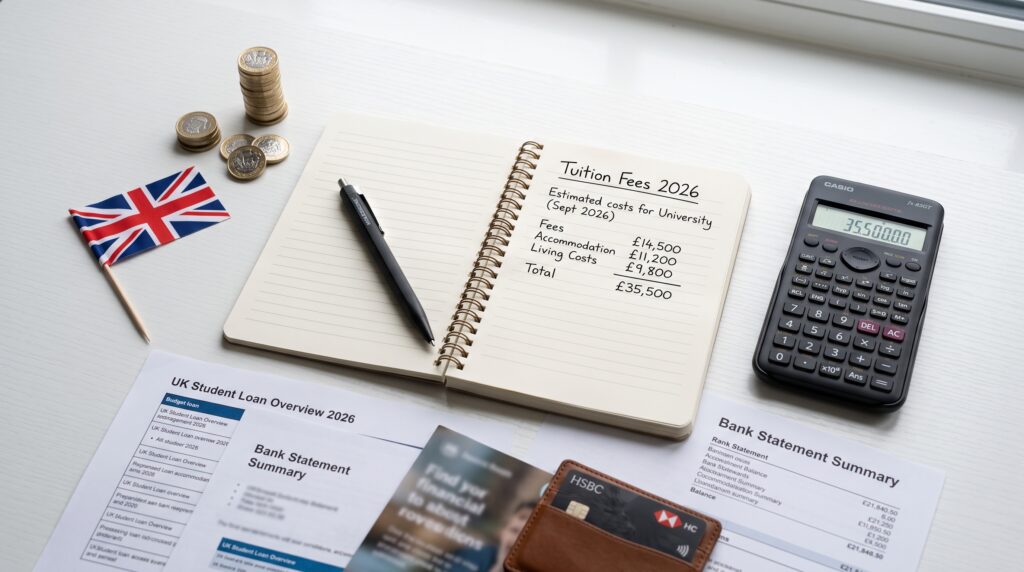
To get a Student visa you need a Confirmation of Acceptance for Studies (CAS) from a licensed sponsor, proof of English at the right level, a valid passport and proof of funds. The funds equal your first-year tuition (what is still unpaid, within the rules) plus up to nine months of living costs. The living-cost figure depends on your application date:
| Study location | Monthly (to 29 Nov 2026) | Monthly (from 30 Nov 2026) | Funds for 9 months (before) | Funds for 9 months (after) | Difference |
|---|---|---|---|---|---|
| London, 9 months | £1,529 | £1,570 | £13,761 | £14,130 | £369 |
| Outside London, 9 months | £1,171 | £1,203 | £10,539 | £10,827 | £288 |
The fee is £558 and the Immigration Health Surcharge is £776 per year of your visa, paid when you apply. For a one-year master’s applicant, here is the visa-stage cash before tuition:
| One-year master’s applicant | Visa fee + health surcharge + funds, excluding tuition |
|---|---|
| London, applying before 30 Nov 2026 | £15,095 |
| London, applying on or after 30 Nov 2026 | £15,464 |
| Outside London, applying before 30 Nov 2026 | £11,873 |
| Outside London, applying on or after 30 Nov 2026 | £12,161 |
The date trap. Applications made before 30 November 2026 are assessed under the lower figure, and those on or after that date under the higher one. The accommodation deduction also rises from £1,529 to £1,570. You must hold the money for 28 consecutive days, and a bank statement ending too early can fail even if the balance is right. If your CAS is ready, apply before the date. Use the UK Student Visa Proof of Funds Calculator to check your exact amount.
How to apply
Apply online on GOV.UK, pay the fee and surcharge, and prove your identity with the UK Immigration ID Check app or at a visa application centre. Apply up to six months before your course starts, and do not wait: your CAS stays valid for a limited time. The UK now issues a digital eVisa instead of a plastic BRP card. Courses of up to six months fall under the visitor route instead of a Student visa, and visitors cannot work.
Student Life in the UK: What Other Guides Skip
The details below shape your first year as much as tuition does.
Accommodation and the Renters’ Rights Act
The Renters’ Rights Act 2025 came into force in England on 1 May 2026. In a private rental, landlords can ask for only one month’s rent in advance (before 2026 some international students were asked for six months or a year), no-fault Section 21 evictions are abolished and deposits stay capped at five weeks’ rent and must be protected within 30 days. University halls and most purpose-built student accommodation are exempt because you hold a licence, not a tenancy. Scotland, Wales and Northern Ireland have their own rules. If you have no UK guarantor, ask your university about guarantor schemes before you sign.
Money and your first week
Set up a UK bank account early, because most landlords and employers expect one. Many banks ask for proof of enrolment and a UK address, so check what each accepts from international students. Keep your passport, CAS and tenancy documents together, and register with your university’s student services in week one.
Working part-time
Most degree-level Student visa holders can work up to 20 hours a week in term time and full time in official vacations. Work does not count toward your proof of funds. At the minimum wage rates from 1 April 2026, 20 hours earns:
| Age | Minimum hourly rate (from 1 April 2026) | 20 hours a week, gross | Roughly a month, gross |
|---|---|---|---|
| 21 and over | £12.71 | £254.20 | £1,102 |
| 18 to 20 | £10.85 | £217.00 | £940 |
These figures are gross, before tax and national insurance. See our guide to student part-time work rules in Canada for a comparison of work limits.
Health care and the NHS
The £776-a-year surcharge gives you access to the NHS, including GP visits, hospital care and emergency treatment. Register with a local GP near your accommodation in the first weeks. Charges such as dental treatment, eye tests and prescriptions may still apply, and they differ between England, Scotland, Wales and Northern Ireland. Most universities also run counselling and wellbeing services.
Getting around and travelling in Europe
A railcard and student discount cards cut travel and shopping costs. A UK Student visa does not let you travel to the Schengen area, so check the visa rules for the countries you plan to visit. Our guide to Schengen scholarships and visas explains the difference between short-stay and long-stay visas.
Food, community and culture
Student unions run societies for almost every country, faith and hobby, and welcome weeks are the easiest time to join. Larger cities have large Asian, African and Middle Eastern grocery and halal markets, which can make cooking at home both cheaper and more familiar.

UK Scholarships for International Students 2027
Scholarships can cut or cover your costs. These are the main routes for 2027 entry:
| Scholarship | What it gives | Next deadline |
|---|---|---|
| Chevening | Full funding for a one-year master’s | Closed on 6 October 2026; the next round normally opens in early August 2027 |
| Commonwealth Master’s Scholarships | Tuition, airfare and a living allowance, for eligible Commonwealth countries via a nominating agency | 20 October 2026, 16:00 BST |
| Gates Cambridge | Full cost, including a £23,152 maintenance allowance for 12 months (2026-27) | 8 December 2026 or 6 January 2027 |
| Clarendon (Oxford) | Fully funded graduate study; considered automatically with your course application | Oxford’s December 2026 or January 2027 course deadline |
| GREAT Scholarships | At least £10,000 towards tuition for a one-year taught master’s; 140+ awards at 60+ universities for students from 18 countries in 2026-27 | Set by each university; many fell between March and May |
| Felix Scholarships | Postgraduate awards at Oxford, Reading and SOAS for students from India and other eligible developing countries | Set by each university (SOAS closed on 2 March in 2026) |
| Saltire Scholarships | Scottish Government awards for postgraduate students from selected countries; confirm the current amount | Check the Scottish Government page |
Many universities also give automatic merit awards and departmental bursaries, so read each university’s international scholarships page. For a wider list, see our top 25 fully funded scholarships for developing countries, our 50+ fully funded scholarships guide, the Chevening guides on recommendation letters and essay writing, and the Commonwealth reference letter guide. Most awards need strong references, so read our guide to a recommendation letter for a scholarship.
The Graduate Visa: Working After You Study in UK
The Graduate visa lets you work or look for work at any level after your degree, with no job offer. Bachelor’s and master’s graduates who apply on or after 1 January 2027 get 18 months, while those applying before then still get two years. PhD graduates get three years. The fee is £937, and the health surcharge is £1,035 per year of permission, so a two-year visa costs £937 plus £2,070. You cannot extend it, and time on it does not count toward settlement.
The usual next step is a Skilled Worker visa, which needs a sponsored job paying at least £41,700, or £33,400 for new entrants and jobs on the Immigration Salary List. Graduates can also switch to the Global Talent or Innovator Founder routes. Plan your next visa at least a year before your Graduate visa ends.
Study in UK Application Timeline for September 2027
| When | What to do |
|---|---|
| 15 October 2026 (tomorrow) | UCAS deadline for Oxford, Cambridge, and medicine, dentistry and veterinary courses for 2027 entry |
| 20 October 2026 | Commonwealth Master’s Scholarships close |
| Before 30 November 2026 | If your CAS is ready (for example for a January start), apply before the funds increase |
| 8 December 2026 and 6 January 2027 | Gates Cambridge deadlines, by course |
| Mid-January 2027 | UCAS main undergraduate deadline for most courses (check the exact date on UCAS) |
| 1 January 2027 | Graduate visa permission falls to 18 months for new applications |
| March to May 2027 | Many GREAT Scholarship deadlines; scholarship decisions |
| Up to six months before your course | You can usually apply for the Student visa; apply with your CAS |
| September 2027 | Courses begin |
How to Study in UK: Step by Step
- Choose a course and city that fit your budget. Compare tuition and living costs, and decide where to study. Outside London, student budgets are usually lower.
- Check deadlines and apply. Apply through UCAS for undergraduate study (Oxford, Cambridge and medicine close on 15 October) and directly to universities for postgraduate study.
- Apply for funding early. Apply for scholarships and university awards, and note that Chevening, Commonwealth and Gates Cambridge each have their own dates.
- Accept your offer and get your CAS. Pay any deposit, meet the conditions of your offer and collect your Confirmation of Acceptance for Studies.
- Prepare your visa funds. Use the proof of funds calculator, put the money in an accepted account for 28 consecutive days and apply before 30 November 2026 if you can to use the lower figure.
- Apply online and give your biometrics. Submit the Student visa application on GOV.UK, pay the £558 fee and the health surcharge, and complete identity checks.
- Prepare for arrival. Arrange accommodation under the new Renters’ Rights rules, set up your bank account, register with a GP and get ready to use your digital eVisa.
Your application also needs a personal statement and references. See our guides to a personal statement for a scholarship, the English proficiency certificate and scholarships without IELTS.
Common Mistakes When You Study in UK
- Using old visa figures. £1,334 and £1,023 a month, and a £524 fee, were outdated years ago.
- Missing the 30 November date when you could have applied under the lower funds figure.
- Moving money in at the last minute. The funds must be held for 28 consecutive days.
- Counting expected part-time wages toward your visa funds. Work income does not count.
- Paying a year’s rent upfront. In a private rental in England, landlords can ask for only one month’s rent in advance.
- Assuming you can bring your family on a taught master’s course.
- Ignoring the Graduate visa change. It drops to 18 months for applications from 1 January 2027.
Frequently Asked Questions About Study in UK
How much does it cost to study in UK for international students in 2026-27?
Tuition for international undergraduates ranges from about £11,400 to £38,000 a year, while living costs add roughly £800 to £2,000 a month depending on the city. Add £558 for the visa and £776 a year for the health surcharge. Use our free study abroad cost calculator to build your own figure.
How much money do I need to show for a UK student visa in 2026?
You must show your first-year tuition (up to £9,000 per the rules for the first year, or what is unpaid) plus living costs for up to nine months: £1,529 a month in London or £1,171 outside London until 29 November 2026. From 30 November 2026 the figures are £1,570 and £1,203.
When does the UK student visa maintenance requirement increase?
On 30 November 2026. Applications made before then are assessed under £1,529 (London) and £1,171 (outside London). On or after that date, nine months costs £14,130 in London and £10,827 elsewhere, which is £369 and £288 more.
What is the UK student visa fee in 2026?
The Student visa application fee is £558 for applications from outside the UK, plus the Immigration Health Surcharge of £776 per year of your visa.
How long must I hold the money for the UK student visa?
You must hold the funds for 28 consecutive days, and your bank statement should be dated within 31 days of your application. Check the exact evidence rules on GOV.UK before you apply.
Can international students work while they study in UK?
Most degree-level Student visa holders can work up to 20 hours a week in term time and full time in official vacations. At the National Living Wage of £12.71 (21 and over), 20 hours earns about £254 a week gross.
What is the UK Graduate visa in 2027?
Bachelor’s and master’s graduates who apply on or after 1 January 2027 receive 18 months of permission instead of two years, while PhD graduates still receive three years. The fee is £937 plus £1,035 a year for the health surcharge.
Can I bring my family when I study in UK?
Usually not. Since 2024, international students on taught master’s courses cannot bring dependants. PhD and other research postgraduates, and some government-funded scholars, still can.
Which UK cities are cheapest for international students?
Sheffield, Nottingham, Leeds, Glasgow and Birmingham are generally cheaper than London, with typical student budgets of about £800 to £1,200 a month. Treat these as estimates and check local rents.
What scholarships can I get to study in UK in 2027?
Chevening, Commonwealth, Gates Cambridge, Clarendon, GREAT Scholarships (at least £10,000 off tuition), Felix and Saltire are the main options, and most universities also run their own awards. Dates vary, so check each page.
What is the international student levy?
From the 2028-29 academic year, English universities will pay £925 a year for each international student. The levy is charged to universities, not to students, but it may affect fees and scholarships.
Do I need IELTS to study in the UK?
Most universities set their own English requirement, and the Student visa needs degree-level English at B2. Some accept alternatives or proof that your previous study was in English, so check the course page before you pay for a test.
Related Reading
- Top 25 fully funded scholarships for developing countries
- 50+ fully funded scholarships guide
- Europe scholarships for international students
- Schengen scholarships
- Canada scholarships for international students
- Scholarship deadlines: apply now
Official sources: GOV.UK’s Student visa: money you need page, the Home Office Statement of Changes HC 584, the Migration Observatory briefing on student migration, the QS World University Rankings 2027, the British Council’s GREAT Scholarships pages and the Low Pay Commission.
Conclusion
The smart way to study in UK is to price your whole first year before you apply: tuition, living costs, the visa fee and surcharge, and the funds you must show. Check each figure on GOV.UK and on your university’s pages, because visa amounts and scholarship dates change. Use the two calculators above to test your plan before you commit.
[…] Dive right into the list of all Top Scholarships in United Kingdom that are available for international students and UK […]
I apologise, but you could not give little bit more information.