

Last updated: June 2026 · Reading time: 20 minutes · Study Tribune Scholarships Desk
The DAAD Scholarship 2026-2027 is the world’s largest fully funded international scholarship programme — not just the largest in Germany, not just the largest in Europe, but the largest scholarship funding organisation on the planet. With an annual budget exceeding €600 million and over 100,000 scholars funded every year, DAAD (Deutscher Akademischer Austauschdienst) has been building bridges between the world’s brightest minds and Germany’s world-class universities since 1925. For 2026-2027, the DAAD scholarship pays Master’s students €992 per month and PhD candidates €1,400 per month — updated in February 2026 — on top of free tuition at German public universities, full health insurance, and a return travel allowance.
What makes DAAD structurally different from most scholarship programmes is Germany’s tuition fee policy. At TU Munich, RWTH Aachen, Heidelberg, Humboldt, and over 350 other public German universities, international students pay no tuition at all — only a semester administration contribution of €70 to €430. DAAD funding on top of free tuition means the scholarship genuinely covers your full cost of study rather than merely reducing it. For students from Pakistan, Nigeria, India, Bangladesh, Kenya, Egypt, and across the developing world, this combination produces one of the most financially complete study packages available anywhere.
This guide covers every aspect of the DAAD scholarship 2026-2027 cycle: all five major programmes, full eligibility requirements, the complete document checklist, all deadlines, the step-by-step application process, and the specific strategies that separate winning motivation letters from the majority. Whether you are a professional from a developing country targeting the EPOS programme, a recent graduate applying for the Studienstipendium, or a researcher applying for a doctoral grant, this is the complete guide you need before you begin.
What Does the DAAD Scholarship 2026-2027 Actually Cover?
The DAAD package is not just a monthly stipend — it is a layered financial package that, when totalled correctly, is worth considerably more than the headline figure. Here is every benefit explained:
| Benefit | What the DAAD Scholarship Covers |
| Monthly Stipend | €992/month for Master’s and first professional degree students | €1,400/month for PhD/doctoral candidates (updated February 2026) |
| Tuition Fees | Germany’s public universities charge no tuition — international students pay only a semester administration contribution of €70–€430 |
| Health, Accident & Liability Insurance | Full health insurance for the duration of the scholarship. Accident and personal liability insurance also included — worth several hundred euros per year |
| Return Travel Allowance | Economy class international flights at the start and end of your programme — significant for students flying from Pakistan, Nigeria, Bangladesh, or Kenya (flights typically €700–€1,200) |
| One-Off Study Allowance | €460 one-off payment on arrival for course materials, registration costs, and initial setup expenses — separate from monthly stipend |
| German Language Course | Funded 2-month intensive German language course before programme begins for students in German-taught programmes — accommodation and subsistence included |
| Monthly Rent Subsidy | Available under certain circumstances based on financial situation and city of placement |
| Family Allowance | Monthly allowance for accompanying spouse and/or dependent children under certain programme conditions |
DAAD Scholarship 2026-2027 — Quick Reference
| Detail | Information |
| Full Name | Deutscher Akademischer Austauschdienst (German Academic Exchange Service) |
| Organisation | German government-backed, non-profit, established 1925 |
| Study Destination | Germany — 350+ accredited public universities |
| Degree Levels | Master’s, PhD/Doctoral, Postdoctoral, Research Stays, Undergraduate (limited) |
| Fields Covered | All academic disciplines — STEM, humanities, social sciences, arts, law, medicine |
| Scholars Funded Annually | 100,000+ from over 130 countries |
| Annual Budget | €600 million+ |
| Master’s Stipend | €992/month |
| PhD/Doctoral Stipend | €1,400/month (updated February 2026 from €1,300) |
| Postdoctoral Stipend | €1,700–€2,150/month |
| Tuition Fees | None at public German universities |
| Main Application Deadline | October 31, 2026 (most Master’s and PhD programmes) |
| Programme Start | October 1, 2027 (or earlier with German language course) |
| Acceptance Rate | 10%–25% depending on programme and field |
| Official Portal | daad.de / funding-guide.de |
DAAD Scholarship Programmes 2026-2027 — Which One is Right for You?
DAAD is not one scholarship — it is a family of over 100 programmes covering different academic levels, nationalities, fields, and career stages. The five programmes below cover the vast majority of Study Tribune readers from South Asia, Africa, and the Middle East. Read each description carefully and identify which programme matches your profile before beginning your application.
1. EPOS — Development-Related Postgraduate Courses (Priority Programme for Developing Countries)
EPOS is the flagship DAAD programme specifically designed for professionals from developing and newly industrialised countries. It funds Master’s and PhD study in German postgraduate programmes with a direct connection to sustainable development in the applicant’s home country. Over 300 German postgraduate programmes are available through EPOS, covering public health, environmental management, agriculture, engineering, urban planning, economics, and dozens of other development-relevant disciplines.
EPOS is the programme most directly aligned with the Study Tribune audience — professionals from Pakistan, Nigeria, Bangladesh, Kenya, Egypt, and other DAC-listed countries who have 2 or more years of work experience after their bachelor’s degree. The development motivation requirement is not a bureaucratic box to tick: the selection panel takes it seriously, and your application must demonstrate a specific, credible connection between your proposed programme and the development challenges of your home country.
| Detail | Information |
| Programme | EPOS — Development-Related Postgraduate Courses |
| Target Applicants | Professionals from developing countries (DAAD DAC list) |
| Degree Levels | Master’s and PhD |
| Academic Requirement | Bachelor’s degree (minimum 4 years); upper third of graduating class |
| Work Experience | Minimum 2 years of relevant full-time professional experience after first degree |
| Motivation Requirement | Development-related academic/professional motivation linked to home country |
| Residency | Applicants resident in Germany for more than 15 months at deadline are ineligible |
| Stipend | €992/month (Master’s) | €1,400/month (PhD) |
| Deadline | October 15–31, 2026 (varies by specific programme) |
| Official Source | daad.de → search ‘EPOS’ in funding-guide.de |
2. DAAD Study Scholarship (Studienstipendium) — Master’s in All Disciplines
The Studienstipendium (Study Scholarship) is the most broadly applicable DAAD programme — open to international graduates from any country who hold a bachelor’s degree and wish to pursue a Master’s at a German university in any academic field. Unlike EPOS, there is no work experience requirement and no development motivation requirement. Strong academic performance and a clear, well-reasoned study plan are the primary selection criteria.
The Studienstipendium is the right programme for recent graduates from any country who are in the top third of their graduating class and have identified a specific German Master’s programme that addresses a gap in their academic or professional development. Duration is up to 24 months — the full length of most German Master’s programmes.
| Detail | Information |
| Programme | DAAD Study Scholarship (Studienstipendium) |
| Target Applicants | International graduates from any country worldwide |
| Degree Level | Master’s / First Postgraduate Degree |
| Academic Requirement | Bachelor’s degree; top third of graduating class (GPA 3.5/4.0+ or 75%+) |
| Degree Age | Completed no more than 6 years before the application deadline |
| Work Experience | Not required |
| Fields | All disciplines — no subject restriction |
| Stipend | €992/month |
| Duration | Up to 24 months |
| Deadline | October 31, 2026 |
| Official Source | funding-guide.de → filter by ‘Study Scholarship’ |
3. DAAD Research Grants — Doctoral Candidates and Postdoctoral Researchers
DAAD Research Grants fund PhD candidates and postdoctoral researchers from any country who wish to conduct research at a German university or research institution. Unlike the EPOS and Studienstipendium which fund degree programmes, Research Grants fund research stays of 1 to 24 months — with or without a concurrent degree enrolment. This makes them particularly flexible for researchers at any career stage who need to access German laboratory facilities, archives, or academic networks.
Doctoral candidates receive €1,400 per month — the same as EPOS PhD awardees. Postdoctoral researchers receive €1,700 to €2,150 per month, making this one of the most financially competitive postdoctoral funding options globally. A formal invitation from a German host institution is required before applying.
| Detail | Information |
| Programme | DAAD Research Grants — Doctoral and Postdoctoral |
| Target Applicants | PhD candidates and postdoctoral researchers from any country |
| Research Duration | 1 to 24 months (flexible) |
| Requirement | Formal invitation from German host university or research institution |
| Research Proposal | Required — must be specific, feasible, and clearly connected to host institution |
| Doctoral Stipend | €1,400/month |
| Postdoctoral Stipend | €1,700–€2,150/month |
| Additional Benefits | Health insurance + travel allowance + one-off arrival allowance |
| Deadline | October 31, 2026 |
| Official Source | daad.de → Research Grants section |
4. RISE Germany — Summer Research Internship for Undergraduate Students
RISE (Research Internships in Science and Engineering) is DAAD’s programme for undergraduate students in natural sciences and engineering who want to gain research experience in Germany during their summer break. Fellows work with a German PhD student or postdoctoral researcher on a real research project for 6 to 12 weeks, receiving a monthly stipend to cover living costs. RISE is an excellent entry point into the DAAD network for students who plan to apply for a full DAAD scholarship at postgraduate level in future cycles.
| Detail | Information |
| Programme | RISE Germany — Research Internships in Science and Engineering |
| Target Applicants | Undergraduate students in natural sciences, engineering, and related fields |
| Duration | 6 to 12 weeks (summer period) |
| Stipend | €861/month |
| Additional | Travel subsidy and health insurance |
| Work Experience | Contributes to future full DAAD scholarship applications |
| Deadline | November 30, 2026 (for summer 2027) |
| Eligible Nationalities | Students studying at universities outside Germany |
| Official Source | daad.de/rise |
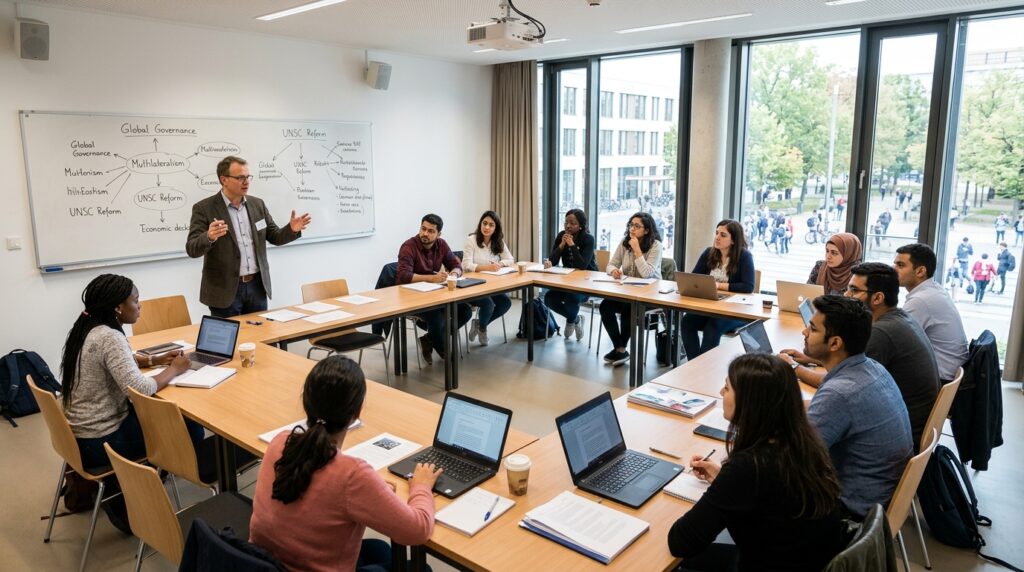
5. Helmut Schmidt Programme — Public Policy and Good Governance
The Helmut Schmidt Programme funds international professionals seeking a Master’s degree in public policy, international relations, political science, economics, law, or governance at a German university. Named after Germany’s former Chancellor Helmut Schmidt, the programme specifically targets professionals with government or public sector experience who intend to return to leadership positions in their home countries after their degree.
The Helmut Schmidt Programme has an earlier deadline than most other DAAD programmes — July 31, 2026 — making it the most time-sensitive programme for 2026-27 applicants reading this guide. If you are a public sector professional with a bachelor’s degree, at least 2 years of work experience in government or civil society, and a clear ambition to lead policy change in your home country, this programme should be your first application.
| Detail | Information |
| Programme | Helmut Schmidt Programme — Public Policy and Good Governance |
| Target Applicants | Public sector and civil society professionals from developing countries |
| Degree Level | Master’s in public policy, international relations, economics, law, or governance |
| Academic Requirement | Bachelor’s degree; strong academic record |
| Work Experience | Minimum 2 years in government, civil society, or public sector |
| Stipend | €992/month |
| KEY DEADLINE | July 31, 2026 — earlier than all other DAAD programmes |
| Language | English or German depending on programme |
| Official Source | funding-guide.de → filter by ‘Helmut Schmidt’ |
| ⚠️ Helmut Schmidt Deadline is July 31, 2026 — Act Now Unlike most DAAD programmes which close October 31, the Helmut Schmidt Programme closes July 31, 2026. If you are a public sector professional from a developing country, this deadline is less than 6 weeks away from publication of this guide. Begin your application documents immediately. |
DAAD Scholarship 2026-2027 Eligibility — Complete Requirements
DAAD eligibility requirements vary slightly by programme, but the core criteria below apply across all five major programmes. Verify against your specific programme at daad.de before applying.
Academic Requirements
- Bachelor’s degree: Minimum 4-year bachelor’s degree for Master’s applications; Master’s degree for PhD/Research Grant applications
- Academic performance: Upper third of your graduating class — approximately GPA 3.5/4.0 or above, or a first or upper second class classification in systems using honours degrees
- Degree age: Most programmes require your highest completed degree to be no more than 6 years old at the application deadline of October 31, 2026
- Professional experience (EPOS and Helmut Schmidt): Minimum 2 years of full-time relevant professional work experience after completion of first degree
- Field alignment: Your proposed programme must be academically and/or professionally connected to your prior education and career — DAAD panels identify misaligned applications quickly
Nationality and Residency
- EPOS programme: Citizens of countries on the DAAD DAC list — this covers most of Asia, Africa, the Middle East, and Latin America. Check daad.de for the full list
- Studienstipendium: Open to all nationalities without country restriction
- Research Grants: Open to all nationalities
- Residency restriction (EPOS): Applicants who have been residing in Germany for more than 15 months at the application deadline are generally ineligible for EPOS
Language Requirements
- English-taught programmes: IELTS 6.0 minimum overall (no band below 5.5) OR TOEFL iBT 80+. Institutional TOEFL is not accepted — must be official Test Taker Score Report from ETS
- German-taught programmes: TestDaF 4×4 (all four components at level 4) or DSH-2 certificate — B2 to C1 equivalent
- IELTS/TOEFL booking timeline: Book your test at least 3 months before the October deadline — slots fill quickly in August and September in Pakistan, Nigeria, India, and Bangladesh
| ✅ Can I Apply for DAAD Without IELTS? Yes — if you choose a German-taught programme. IELTS and TOEFL are only required for English-medium instruction programmes. For German-taught programmes, TestDaF or DSH certification is required instead. Crucially, DAAD funds a free two-month intensive German language course before your programme begins — so no prior German is required to apply. This is the clearest and most accessible scholarships-without-IELTS pathway available to international students in the DAAD system. |
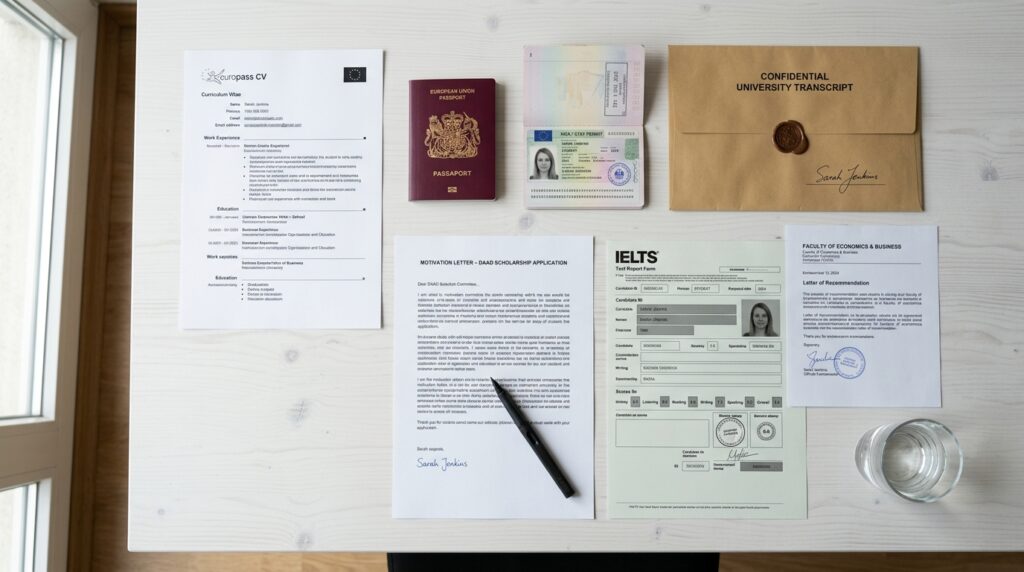
Required Documents — DAAD Scholarship 2026-2027 Complete Checklist
Begin collecting these documents at least 3 months before your application deadline. Certified translations alone can take 2 to 4 weeks, and IELTS or TOEFL test slots need to be booked 6 to 8 weeks in advance. Document collection is where most DAAD applications stall or fail.
| DAAD Scholarship 2026-2027 — Complete Document Checklist DAAD Application Form — downloaded from daad.de, personally signed with current date Europass CV — in official Europass format from europass.europa.eu, personally signed and dated Motivation Letter — maximum 2 pages, personally signed with current date, in English or German only Two Academic Reference Letters — on official institutional letterhead, signed and dated, submitted unsealed Employer Confirmation Letter (EPOS only) — on official letterhead with institutional stamp, current date Certificates of Employment (EPOS) — proving minimum 2 years of relevant professional experience after first degree Language Certificate — IELTS (6.0+) or TOEFL iBT (80+) for English-taught programmes; TestDaF 4×4 or DSH-2 for German-taught Certified Degree Certificates — bachelor’s and any postgraduate degrees, with certified English or German translation Certified Academic Transcripts — all years from all institutions, with grading scale explanation, with certified translation if not in English/German APS Certificate (China applicants only) — Academic Evaluation Centre certificate required from Chinese applicants |
| ⚠️ Critical Application Rules — Read Before Submitting 1. Complete applications must be submitted in English or German only — no other language is accepted. 2. You may apply to a maximum of 3 programmes per cycle — list them in strict priority order. 3. Do not change the order once submitted. 4. Keep certified copies of all documents — DAAD may request digital versions after university shortlisting. 5. Certified translations take 2 to 4 weeks — do not leave them until September. |
DAAD Scholarship 2026-2027 Deadlines — Full Programme Calendar
DAAD operates through individual German universities, which receive applications first and then nominate candidates to DAAD centrally. Your personal preparation deadline should be at least 2 weeks earlier than the dates below to allow for administrative processing and technical issues.
| Programme | Deadline | Notes |
| Helmut Schmidt — Public Policy & Governance | 31 July 2026 | Earlier than all other programmes — act immediately |
| Study Scholarship — Architecture | 24 September 2026 | Portfolio submission may be required |
| Study Scholarship — Music | 25 September 2026 | Audition/performance recording may be required |
| EPOS — Development-Related Postgraduate | 15–31 October 2026 | Varies by specific programme — verify at funding-guide.de |
| Study Scholarship (Studienstipendium) — All Disciplines | 31 October 2026 | Main annual deadline for most Master’s programmes |
| Research Grants — Doctoral and Postdoctoral | 31 October 2026 | Requires host institution invitation letter |
| Study Scholarship — Fine Art, Design, Film | 10 November 2026 | Portfolio and creative work samples required |
| Study Scholarship — Performing Arts | 10 November 2026 | Audition recording required |
| RISE Germany — Summer Internship | 30 November 2026 | For summer 2027 research placement |
How to Apply for the DAAD Scholarship 2026-2027 — Step by Step
DAAD’s application process is unusual compared to most scholarship programmes: you do not apply to DAAD directly at first. The process begins at the level of individual German universities and only reaches DAAD after shortlisting. Here is the exact sequence:
- Browse the DAAD scholarship database: Go to funding-guide.de. Filter by your academic level, field of study, and nationality. This shows you all DAAD programmes available to your profile, with specific German universities and programme deadlines.
- Choose up to 3 programmes in priority order: Research the curriculum, teaching language, city, supervisor profiles, and ranking of each university. Choose 3 programmes that genuinely match your academic background and career direction. You cannot change the priority order once submitted.
- Contact your proposed supervisor (Research Grants only): For Research Grants and PhD applications, identify and contact your proposed German host researcher before applying. A named supervisor who has confirmed interest in your research proposal significantly strengthens your application.
- Prepare all documents: Assemble your complete document pack — Europass CV, motivation letter, two reference letters, transcripts, degree certificates, language certificate, and employer letters if required. Start this in July — not September.
- Apply directly to German universities: Submit your complete application package to the universities offering your chosen programmes. Do not send to DAAD at this stage. Each university has its own submission process — paper, email, or online portal depending on the institution.
- University shortlisting: University selection committees review applications and nominate a shortlist to DAAD. You will receive an email from DAAD at this stage with a link to the official DAAD Portal for digital document upload.
- Upload documents to DAAD portal: Upload all required documents in the formats specified in your DAAD portal invitation. Ensure all documents are in English or German. Check each document for signature and date before uploading.
- Interview (some programmes): EPOS, Helmut Schmidt, and doctoral programmes more commonly include an interview — typically 30 minutes conducted by a DAAD-appointed panel. See the Interview section below.
- Results notification: Results are communicated February to May 2027. Successful candidates receive an award letter and begin pre-departure preparation with DAAD’s German partner organisations.
How to Write a Winning DAAD Motivation Letter
The motivation letter is the single document that determines whether a technically eligible candidate wins or loses the DAAD scholarship. With acceptance rates of 10 to 25%, this is where the difference is made. The maximum length is 2 pages — never exceed this.
The Four-Part Structure That Works
- Opening (100–150 words): State your full name, current position, the specific DAAD programme you are applying for, and your target German university and programme. Be precise from sentence one: ‘I am applying for the DAAD EPOS scholarship for the Master’s in Environmental Management at the University of Freiburg’ — not a paragraph about how Germany is a great country. Committees read hundreds of letters and reward directness.
- Your professional experience and the problem you work on (200–300 words): Describe your current role specifically — name the organisation, scope of responsibility, and the concrete professional challenges you face. Then name the specific gap in your expertise that this German programme addresses. This is the section most applicants underwrite. The more specific and personal this section is, the stronger your letter will be.
- Why this programme, this university, this time (200–300 words): Explain why this specific German programme’s curriculum addresses your specific professional gap. If you have identified a professor whose research aligns with your work — name them and describe their research. Generic university praise scores lower than specific programme analysis.
- Your development contribution and return plan (150–200 words): How will this degree improve conditions in your home country? Be specific: which sector, which population, which problem, and what your enhanced expertise will concretely change. Write your 10-year career trajectory with the same specificity you would bring to a business plan. This is the section EPOS and Helmut Schmidt panels weight most heavily.
What to Avoid in Your DAAD Motivation Letter
- Do not open with ‘I am honoured to apply’ or any variation — it is the most common first line and signals a template document to experienced reviewers
- Do not describe Germany, DAAD, or your target university in flattering but generic terms — reviewers identify copied phrasing immediately
- Do not exceed 2 pages — longer letters are truncated in review and signal poor judgement
- Do not submit AI-generated prose without substantial personal revision — DAAD panel members identify it consistently and it produces generic, uncompetitive letters
- Do not use the same letter across multiple programmes — the specific programme, university, and development connection must be different for each of your 3 applications

Cost of Living in Germany on a DAAD Stipend — City by City
The DAAD stipend of €992/month for Master’s students and €1,400/month for PhD candidates covers actual living costs in Germany — but the surplus varies significantly by city. Germany’s cities range from expensive (Munich, Frankfurt) to genuinely affordable (Leipzig, Dresden). Choosing a programme in a mid-sized or smaller German city can mean significant monthly savings.
| City | Monthly Budget | DAAD Verdict | Key Advantage |
| Munich | €1,200–€1,600 | PhD stipend tight; Master’s requires careful budgeting | Germany’s #1 ranked university (TU Munich QS #30) |
| Frankfurt | €1,100–€1,500 | Budget carefully at both stipend levels | Finance, law, and economics hub |
| Hamburg | €1,000–€1,400 | PhD comfortable; Master’s manageable | Environmental sciences, law, culture |
| Cologne | €950–€1,300 | Both levels workable | RWTH Aachen nearby; strong engineering |
| Berlin | €950–€1,200 | Both workable with shared housing | Humboldt, FU Berlin, TU Berlin — three top universities |
| Heidelberg | €900–€1,150 | Comfortable for both levels | QS #86; medicine, biosciences, law |
| Göttingen | €750–€950 | Significant monthly surplus | Life sciences; relatively low competition |
| Leipzig | €700–€900 | Best value — surplus to save | Growing tech scene; affordable housing |
| Dresden | €700–€900 | Very comfortable — meaningful surplus | Engineering, STEM; beautiful city |
| 💡 Deutschland Ticket — €63/month for Nationwide Travel The Deutschland Ticket (€63/month as of January 2026) covers public transport across Germany nationwide — trains, trams, buses, and metro in all cities and regions. For DAAD scholars, this single ticket eliminates most local transport costs and enables affordable weekend travel across Germany and to neighbouring countries. Factor this positively into your city budget calculations. |
What the DAAD Scholarship Package is Worth in Real Terms
To understand the genuine financial value of a DAAD scholarship, here is a full package calculation for a two-year Master’s programme in a mid-cost German city and a three-year PhD programme:
| Benefit | 2-Year Master’s | 3-Year PhD |
| Monthly Stipend | €992 × 24 = €23,808 | €1,400 × 36 = €50,400 |
| Health & Accident Insurance | ~€3,600 | ~€5,400 |
| Return Travel Allowance | ~€1,000 | ~€1,000 |
| Study Allowance (one-off) | €460 | €460 |
| German Language Course (if applicable) | ~€2,000 equivalent | ~€2,000 equivalent |
| Tuition Fees Saved | €0 (public universities charge no tuition) | €0 (public universities charge no tuition) |
| TOTAL ESTIMATED PACKAGE | ~€30,868 | ~€59,260+ |
Top German Universities for DAAD Scholarship Holders
Germany’s public universities are globally ranked and research-intensive. DAAD scholars gain access to the same institutions, faculty, and laboratory facilities as tuition-paying students — with no tuition costs and the credibility of a DAAD award on their academic profile.
| University | City | QS 2026 Rank | Top Fields |
| Technical University of Munich (TUM) | Munich | #30 | Engineering, STEM, life sciences, computer science |
| LMU Munich | Munich | #53 | Medicine, humanities, social sciences, law |
| Heidelberg University | Heidelberg | #86 | Medicine, biosciences, law, natural sciences |
| RWTH Aachen University | Aachen | #106 | Engineering, architecture, natural sciences |
| Humboldt University Berlin | Berlin | #117 | Humanities, social sciences, philosophy, education |
| Freie Universität Berlin | Berlin | #116 | Social sciences, political science, environmental studies |
| University of Bonn | Bonn | #180 | Economics, mathematics, philosophy, natural sciences |
| University of Göttingen | Göttingen | #254 | Life sciences, humanities, STEM, theology |
| University of Frankfurt | Frankfurt | #269 | Finance, economics, law, social sciences |
| University of Hamburg | Hamburg | #240 | Environmental sciences, law, social sciences |
Top 8 Tips to Win the DAAD Scholarship 2026-2027
- Choose programmes that genuinely match your profile — not just your ranking preferences. The most common reason technically eligible DAAD applications fail is a mismatch between the applicant’s academic background, career experience, and the chosen programme. A development economist applying for a programme in film studies will not be shortlisted regardless of grades. Choose programmes where every element of your profile — degree, work experience, and career plan — connects clearly to the programme’s content.
- Start your Europass CV in July — not September. DAAD requires the Europass format specifically, not any other CV style. The Europass template is available at europass.europa.eu and has strict formatting requirements. Complete yours in July. Have it reviewed by someone who knows the format. Sign and date it with your application date.
- Select reference letter writers who will be specific, not generic. Contact both referees in July and provide them with your CV, your motivation letter draft, the specific DAAD programme you are applying for, and the deadline. A letter that describes specific research contributions, named projects, and concrete professional impact is worth ten times a polished but generic endorsement.
- Apply to the Helmut Schmidt Programme before July 31 if you are a public sector professional. This is the most overlooked high-value DAAD programme — it targets exactly the professionals Study Tribune’s audience includes: government officers, civil servants, NGO staff, and policy professionals from developing countries with a bachelor’s degree and 2+ years of work experience. Its July 31 deadline means it must be actioned immediately.
- For the DAAD EPOS programme, the development motivation is not optional — it is the selection criterion. DAAD EPOS panels have read thousands of motivation letters describing how a Master’s in Germany will help the applicant ‘contribute to the development of their country.’ This is not specific enough. Name the sector, the institution you will join or build, the population you will serve, and the policy or practice you will change. Generic development motivation scores at the bottom of the range.
- Apply to DAAD simultaneously with Chevening and AAUW in the same cycle. The document preparation for DAAD, Chevening (UK, October deadline), and AAUW (US, September 30 deadline) overlaps significantly. Transcripts, CV, and language certificates are the same. Motivation letters must be rewritten for each programme. Applying to three programmes simultaneously from the same preparation base triples your chances without tripling your effort.
- Book your IELTS or TOEFL test before August. Test centres in Pakistan, Nigeria, India, Bangladesh, and Egypt fill completely in September and October — the peak period for scholarship application tests. If you wait until August to book, you may not find a test slot before the October 31 deadline. Book in July for an August or September test date.
- If unsuccessful — apply again. DAAD explicitly encourages reapplication. The most common reasons for unsuccessful first applications are the motivation letter (too generic, no specific development contribution), reference letters (too general), and programme mismatch. Request feedback if available, identify the weakest elements, and reapply in the next cycle with a stronger, more targeted application.

Frequently Asked Questions — DAAD Scholarship 2026-2027
Q1: What is the stipend for DAAD scholarship 2026-2027?
For the 2026-2027 cycle, Master’s students and first degree postgraduate students receive €992 per month. Doctoral and PhD candidates receive €1,400 per month — updated from €1,300 in February 2026. Postdoctoral researchers receive €1,700 to €2,150 per month depending on programme. RISE Germany summer internship students receive €861 per month. In addition to these monthly amounts, all awardees receive health and accident insurance, a return travel allowance, and a one-off study allowance of €460. The total package for a 2-year Master’s programme is estimated at approximately €30,000.
Q2: What is the DAAD scholarship deadline for 2026?
Deadlines vary by programme. The Helmut Schmidt Programme closes July 31, 2026 — the earliest of all DAAD programmes. Architecture and Music scholarships close in late September 2026. The main deadline for most programmes — EPOS, Studienstipendium, and Research Grants — is October 31, 2026. Fine Arts, Design, Film, and Performing Arts close November 10, 2026. RISE Germany closes November 30, 2026. Your personal preparation deadline should be at least 2 weeks earlier than the official university deadline to allow for administrative processing.
Q3: Can I apply for the DAAD scholarship without IELTS?
Yes — by choosing a German-taught programme. IELTS and TOEFL are required only for English-medium instruction programmes. For German-taught programmes, TestDaF 4×4 or DSH-2 certification is required instead. Critically, DAAD funds a free two-month intensive German language preparation course before your degree begins for students who choose German-taught programmes — so you do not need prior German language proficiency to apply. This makes DAAD one of the most accessible scholarships-without-IELTS available to international students from Pakistan, Nigeria, India, and elsewhere.
Q4: What is the DAAD scholarship acceptance rate?
DAAD acceptance rates range from approximately 10% to 25% depending on the specific programme and the applicant’s field. Doctoral Research Grants and EPOS are among the most competitive programmes. RISE Germany and some subject-specific Studienstipendium programmes in less competitive fields have acceptance rates toward the upper end of this range. These are not lottery odds — DAAD panels use a structured evaluation process that rewards preparation. A specific, personal motivation letter and strong reference letters that know your work in detail are the two most controllable factors in your acceptance probability.
Q5: Does the DAAD Scholarship 2026-2027 cover tuition fees in Germany?
Effectively yes — not because DAAD pays tuition fees, but because Germany’s public universities do not charge tuition fees for international students. Students pay only a semester administration contribution of €70 to €430 per semester, which covers student services, public transport tickets (in some states), and administrative costs. DAAD’s monthly stipend easily covers this contribution. The net effect is that DAAD scholars study at Germany’s top universities — including TU Munich (QS #30) and Heidelberg (QS #86) — without any tuition cost.
Q6: Who is eligible for the DAAD EPOS scholarship?
EPOS is specifically for professionals from developing and newly industrialised countries on the DAAD DAC list — which covers most of Asia, Africa, the Middle East, and Latin America. Eligibility requires a bachelor’s degree of at least 4 years with performance in the upper third of the graduating class, plus a minimum of 2 years of full-time relevant professional work experience after the first degree. Applicants who have been residing in Germany for more than 15 months at the application deadline are typically ineligible. The chosen programme must have a clear connection to sustainable development in the applicant’s home country.
Q7: How do I write a winning DAAD motivation letter?
The winning DAAD motivation letter follows a four-part structure: an opening that precisely names the programme, university, and your current position; a professional experience section that describes the specific problems you work on and the expertise gap you are addressing; a programme-fit section that names specific curriculum elements or professors at your target university; and a return plan section that states concretely how your degree will improve conditions in your home country. Maximum length is 2 pages. It must be personally signed and dated with the submission date. Do not open with ‘I am honoured to apply’, do not exceed 2 pages, and do not submit the same letter to all three of your programmes — each must be specific to its programme and university.
Q8: Is the DAAD scholarship stipend taxable in Germany?
In Germany, scholarship stipends are generally tax-free up to standard exemption thresholds. The DAAD stipend at €992 per month for Master’s students falls below the personal income tax threshold for most scholars, meaning it is effectively tax-free in practice for students without additional income sources. Income earned from part-time work on top of the DAAD stipend may be taxable above certain thresholds. PhD candidates receiving €1,400 per month are also typically below the threshold when the DAAD stipend is their sole income source. Students are advised to consult the German Finanzamt (tax authority) or their university’s international student office for guidance specific to their individual situation.
Conclusion — Should You Apply for the DAAD Scholarship in 2026?
If you have a strong academic record in the upper third of your graduating class, a clear connection between your professional experience and your chosen German programme, and a credible plan for applying your degree to improve conditions in your home country — the answer is an unqualified yes. The DAAD scholarship combines free tuition, a liveable monthly stipend of €992 to €1,400, full health insurance, and return travel, in one of the world’s strongest higher education systems, at an application cost of zero.
The 10 to 25 percent acceptance rate is competitive. But it rewards preparation, not luck. A thoroughly researched programme choice, a specific and personal motivation letter, strong reference letters from people who know your work in detail, and document collection beginning in July rather than September are the four levers that separate successful DAAD applications from the majority. The main deadline for most programmes is October 31, 2026. The Helmut Schmidt Programme closes July 31, 2026. Start preparing now.
Study Tribune publishes free, annually updated guides to the world’s leading fully funded scholarship programmes. Visit studytribune.com for complete guides to the Chevening Scholarship, AAUW International Fellowship, Australia Awards, Erasmus Mundus, Türkiye Bursları and more — with document checklists, deadline alerts, and application tips delivered to your inbox free every week.